Belaboring the Obvious

Wednesday, May 31, 2006

Starving the Brain to Put on Extra Fat....

Alternet.org has an excerpt from Tamara Draut's new book, Strapped, on the difficulties young adults have in getting situated in the economy, specifically, on college education and the debt it has spawned.

The article does well enough at describing the problem, but seems to place the blame on the federal government's failure to keep grants and low-cost loans matched with demand.

More emphasis should be placed on the reasons why tuition--even at land-grant colleges and universities--through the `80s and `90s rose much more quickly than the rate of inflation and has continued to rise at such high rates.

This problem with public-school tuition began at roughly the same time as major tax cuts for the wealthy and for corporations were implemented at the federal level. Since those tax cuts did not (and will not) make up for the tax revenues lost, the gradual inclination of Congress was to keep funding for education from keeping pace with the actual need. That created part one of the problem.

The second part was that state tax returns, in large part, depend upon the federal return as their basis. When corporations and wealthy (who depend upon corporate investment for their wealth) came to pay state taxes, those taxes were reduced by the same extent as they had been on their federal returns. The end result? Fewer dollars available at the state and local levels.

In the `60s, the share of total federal revenues paid by corporations was about 34%. By the middle `80s, that share was about 24%. By the early `90s, that share was down to roughly 16%. In 2003, 8%. Estimates for the most recent tax years suggest that percentage may go even lower (and if the amount of tax rebates to and subsidies of mature corporations continue, the tax flow may actually go negative--net tax funds flowing out to corporations). It's not beyond common sense to say that this successive drop in federal share is mimicked at the state level.

This tax avoidance scheme is generally defended by the corporate world as necessary to meet its prime requirement of providing the best return for its shareholders. But, they have also been very active in the political process to obtain those tax breaks. Lobbying costs and campaign contributions are at all-time highs.

Supply-side economics is the brainchild of Andrew Mellon--the Treasury Secretary of Harding, Coolidge and Hoover--who presided over the boom of the Roaring `20s and its bust, resulting in the Depression of the `30s, the same theory which Reagan's minions revived, creating huge deficits.

Overlaid onto that supply-side policy has been a deregulation and privatization scheme which has put even more government money into private pockets. There's no incentive to reduce costs (or the interest rates of) student loans by private lenders such as Sallie Mae when the government is underwriting those loans. So, tax cuts have reduced the education grant money available at all levels (compared to need), as well as disproportionately increasing the cost of tuition, and government-privatized loan schemes have provided private investors with a government-secured income stream.

Some may say, "why not? It's not the business of business to pay for people's educations."

Even Adam Smith would say, "yes, it is." The workforce, despite tendencies today in business to think otherwise, is part of the nation's infrastructure. Corporations probably depend upon infrastructure, including education, even more than individuals, and yet, this obsession with shareholder return has become extraordinarily shortsighted, perhaps by design. The most common excuse for outsourcing jobs today is that educated people cannot be found in sufficient quantity at reasonable cost in the U.S. today. While that, now, might be a smokescreen, it may not be in the future.

And, let's remember who the real beneficiaries of this supposed need for greater profit are: the very same people benefitting from reduced taxes on their investments and who can most afford an education for their offspring. While it's always difficult to get a handle on the exact figures for private wealth distribution from equity investment, the top 400 families in the country control 32-33% of the stock, the top 1%, about 50%, top 5%, about 60%, the top 10%, about 80% of the stock.

There are reasons for the increasingly lopsided distribution of wealth in this country, and the foremost one is the same one that's causing the education affordability problems for lots of younger people in this country--preferential tax policies for the super-rich and the corporations driving their wealth.

At precisely the time that we, as a nation, need better-educated people, particularly in the green energy fields (which will require chemists, physicists, mathematicians and well-equipped public university research labs), we're making it much harder for bright, qualified kids to get a university education, in order to increase the wealth of the very class in the country which can afford higher education.

As Molly Ivins has said, "why are only populists accused of class warfare?" It's a good question.

In 1966, Reagan won office as governor of California, promising smaller government, a balanced budget and lower taxes. Classic supply-side, trickle-down economics. His first step toward that end was to put the University of California system "on a paying basis." Before that time, any student who could win a place in the university system competitively could go to college.

When Reagan left office, California government was larger, government spending was larger, there were deficits instead of a balanced budget, and fewer and fewer poor, bright kids were in California schools of higher learning. Reagan's system was transplanted to the federal level twenty-five years ago and we've yet to correct his economic mistakes. In fact, under Bush, we've made them even worse.

If it turns out that oil is in decline, will we be any better off that the energy solutions must still be imported from places like India and China and Japan, or would we be better off growing our own? Do we need bigger financial waistlines for the wealthiest among us, or do we need better brains?


Monday, May 29, 2006

Memorial Day Musings...

... on the tendency of the United States to foster war when it can't have peace on its own exclusive terms.

It's not something Americans like to admit, but for a country which professes through its politicians a great love of peace, we do a whole helluva lot of fighting around the world. We also seem to have a penchant for keeping the fighting going until we can obtain, in George Bush's simplistic terms, "total victory." Sometimes this has been interpreted as total surrender of the enemy.

We've been hearing this off and on for a long, long time. At Versailles, on the USS Missouri, but most particularly in the last few years regarding terrorism. Expecting "total victory" against such opposition will probably work to extend the problem, rather than solve it. (It may be, given human nature, that the best that can be done with terrorism is to minimize it, and to make it more difficult for terrorists to act.)

And, I wonder, if that's the whole point of doing so--extending the problem. That's what we did--or tried to do--with the Soviet Union. By 1980, as a kind of anti-detente backlash, the neo-conservatives had concocted the general notion that the roots of all terrorism worldwide could be traced to the Kremlin, with the help of a book written by Michael Ledeen (despite the acknowledged fact within the CIA that the basis of that belief--and the evidence offered in Ledeen's book--stemmed from black propaganda inserted into, principally, the European press by the CIA itself). Then, when the Soviet Union imploded, the neo-conservatives, led by the writings of Laurie Mylroie, determined, poof!, since the Soviet Union was gone, that the seat of all worldwide terrorism resided several thousand miles to the south, in Baghdad. (One wonders how the transfer of those responsibilities occurred--was it like turning over the keys to an apartment?)

The latest variation on that theme is the one proffered by Rumsfeld, Rice, Cheney, Bush, et al, that world terrorism is a monolithic construct, spanning dozens of countries, with terror cells all reporting back to the shadowy figure of Osama bin Laden, with a military organization chart, full of #2s and #3s and "lieutenants."

It's necessary to think of terrorism in military terms if one wishes to justify the use of the military--rather than law enforcement--to counteract the problem, and to justify larger and larger military budgets, along with more and more military influence in and/or control of society.

If the problem of national defense has become more and more clouded and indistinct, it may be that U.S. leaders have made it so, intentionally, and Bush has done so more than any other. That may be due to his own ineptitude in understanding it, made more complicated by a Manichean outlook on everything in life, or it could be that Bush is simply the carnival barker for neo-conservative ideas which have been seeking the forefront of policy for sixty years.

One thing is certain, though. The approach the Bushies have been taking over the last several years will perpetuate and spread terrorism for many years to come, and there's some history to suggest this is so. In the late `50s, Sayyed Qutb was a founder of what is now known in Egypt as the Islamic Brotherhood. Gamel Abdul Nasser, sensing the threat in the Brotherhood, had Qutb imprisoned. While there, he was tortured. At one point, animal scents were spread on him and he was locked in a cell with dogs. The dogs attacked him and in the struggle, he had a heart attack.

After this event, his writings changed. He had always blamed the West for debasing Egyptian and Muslim culture, and for propping up dictators such as Nasser. Now, he felt that Western spiritual corruption had infected Muslims and had led them to engage in torture of other Muslims. The books he wrote in prison, then smuggled out, reflected this change in his thinking. It convinced him that the corruption was so extensive that it would be permissible to kill Muslim leaders who spread it.

Nasser had Qutb tried and convicted of treason, and Qutb was executed in 1966. But, Qutb's torture-induced philosophy had affected a young Egyptian doctor, from a well-to-do and influential family. That doctor would go on to spread Qutb's ideas, become influential in the Islamic Brotherhood, and would, in 1980, be one of hundreds of people imprisoned and put on trial after members of the Brotherhood in the Egyptian military assassinated Anwar Sadat.

While in prison, this young doctor, too, was tortured by the Egyptian police, and, likely because of that, would come to expand on and refine Qutb's views. He would see the West as the sole source of the corruption, would decide that when Egyptians did not rise up against their government after Sadat's assassination, the masses, too, had become too corrupted to even recognize their debasement. Because of this, he would take his revenge on the West, and on ordinary Muslims who did not embrace an Islamist state.

The doctor's name is Ayman Zawahiri, the so-called #2 to Osama bin Laden. I say "so-called" because intelligence in this country continues to think of bin Laden as the leader, which may be the result of a longstanding and imperfect understanding of the relationship of bin Laden and Zawahiri, an imperfect understanding which works well to perpetuate the myth of terrorism with a military org chart.

But, what binds together the notions of Islamic revolution and Western corruption in the minds of terrorist leaders is torture.

To the torturer, the practice is merely an efficient means of extracting accurate information (a delusional belief, if scientific research is to be believed), but to the tortured, it damages the very soul of the person. To a devout Muslim, the typical practices employed force the individual to confront so many different fears and shames that the end result is truly consciousness-altering, and as with the influential members of the Islamic Brotherhood who were tortured, it forever altered their thinking.

So, what has the United States done in its attempts to obtain "total victory" over terrorism? It has tortured hundreds, perhaps thousands of devout Muslims. Dick Cheney has sought to legitimize the practice and to ignore law prohibiting it.

Somehow, it seems to me that, in that desire to torture are the seeds of our neverending "war on terror." We are doing the precise things required to perpetuate that war, rather than to bring it to a swift end. Moreover, I have come to the conclusion that the politicians pushing the use of torture know what the result will be. More terrorism.

So, on Memorial Day, a day we remember our war dead, we should also realize that we will be remembering a greater number war dead in the next year, and the year after that, and so on, until we realize that the people we torture today will go on, to avenge their shame and their humiliation and to justify their hardened opinions, killing the soldiers our politicians put in harm's way.

Our politicians use soldiers in this "war on terror" to convince us that it can be won militarily (a notion which is suspect, to begin with, and has never been properly debated). Then, they order those soldiers to torture their prisoners, and if experience is to be appreciated, that torture perpetuates the terror on which "war" is being waged.


It's not just a self-fulfilling prophecy. It's a strategy.

Sunday, May 28, 2006

There's Only One Thing Wrong With the Internet...

... and that's that it's full of wackos. There are, at least, several tens of millions of people on the planet that think that Area 51 and Roswell, New Mexico, are exactly the same thing. A large percentage of those people couldn't find either Area 51 or Roswell on a map. At least some try to make a connection in thinking that the Roswell crash products were taken to Area 51 and reverse-engineered.

But, that's not the least of it. If there's a bad diet, or a new chain letter about Jesus, or a message that's sure to change your life, you're going to find it on the internet, or in your morning email. None of it has anything to do with real knowledge. It's all about promoting ignorance and superstition. If you send this email on to eight other people, you'll get everything you ever wanted in life, or Bill Gates will send you $243.10 for forwarding an email.

The internet was supposed to put one onto the highway to knowledge. Instead, it's driven god knows how many millions of people into the superstition ditch--for the same reasons that telemarketers are calling you at dinnertime about your credit card problem and think that by doing so that they're doing you a fucking favor--it was ultimately all about capitalism, nothing more.

And, that's where the so-called anti-net regulation legislation fits in. Somebody (read, AT&T, Verizon, Sprint, Qwest, SPC, et al) wants to make more money off of you. They want to be able to charge you more money to get misinformed by other entities that they want to make money off of, too.

Let's review. After 9/11, what was the self-described most wired-up, tuned-in bunch of people in the world let a bunch of brain-dead twits in the White House talk them into a war with a country that had nothing to do with the problem at hand. Most of those people couldn't find Iraq on a map--just like they couldn't find Area 51 on a map--but they were still sure they were right. Only experience and time showed them what was the truth, a truth that a few people, still possessed of common sense and logic, knew all along.

In the Dark Ages, wandering minstrels sang the news in exchange for a meal and a bed. Given what happened in the Dark Ages, those minstrels must have made most of it up.

Same with the internet today. The minstrels are making a lot of it up, and the minimally-impaired but keyboard-qualified are passing it on to the rest of us as if it were the gospel truth.

Here's a real eyeopener: most of us don't know what the fuck's going on. Period. We aren't in the know. We don't live in the places where the news that affects our lives is being made, and we don't know fuck-all about the people reporting that news. We measure trust by the haircut on the newsreader.

It seems like eons ago now that propaganda was a new concept. Woodrow Wilson's Creel Commission was designed to spread lies in order to get Americans enthused about a war they really weren't enthused about. And, because the government intimated that it was so, people believed that German troops were parading through the streets of Belgium with babies impaled on their bayonets, and that some of those bayoneted babies were eaten afterwards.

So much trust. So many lies.

And yet, it's the most horrible thing in the world to ask, "if this is not true, who benefits?" The least amount of skepticism is met with stolid resistance. You will win a million dollars if you forward this email to twelve true friends. You will get your wish if you just praise god, even though there's a hidden message in the email that you didn't notice supporting George the Younger in his insane pursuits because the email was 1.4 mb long, and most of the friends of yours that really know you will think you have gone completely fucking around the bend for sending it to them, and will take you off their mailing lists because they think you've gone over to the Dark Side.

We are all about to have brain explosions from information overload. Ka-Boom! Brains on the walls around the Barcalounger. Will take days to clean them off the TV screen and the computer monitor, let alone get them out of the carpet.

In the meantime, evil triumphs. Just the way it was intended, all along.

When people cannot tell lies from truth, no matter the source, no matter the outlandishness of the claim, no matter the defiance of common sense implicit in the information, in a democracy, we're just plain doomed. It doesn't matter if the purveyor of the information is Chris Matthews or Brian Williams or Katie Couric or Bill O'Reilly or the conspiracy freak on your favorite forum. If it's not true, how do you know, when everyone is telling you it's so because they're listening to that same drivel without questioning it?

Even the old liberal adage, "question everything," is suspect these days. You might have gotten that million if you'd only sent on that email to twenty of your friends. Even though your ISP would hate you for clogging up their servers.

You know, what I really want right now is a really good bullshit filter for email and browser. I could make a billion (of something) on something like that....


Friday, May 26, 2006

It Should Be a Verb...

... to be "wolcotted." After slicing and dicing Stanley Kurtz's extended lament on why, oh, why can't fiction have real conservative ideological purity, James Wolcott concludes with this little bit:

If this is what Kurtz and his kind are like with The Da Vinci Code, I don't want to be around to hear the caterwauling that may occur should Oliver Stone's World Trade Center become a hit. It'll be like karoke [sic] night among the coyotes.


There's certainly way, way too much emphasis on politics in Hollywood (mostly, Hollywood runs on money and egos, not politics).

And yet, I think conservatives complain about this failure of Hollywood to mimic their values because they just don't get it. Conservative ideology is, well, boring. Their stories don't, by and large, have much dramatic content, and ideological purity of any sort kind of puts the vise grips on dramatic tension and character development.

What conservatives like Kurtz seem to want in a movie is a sort of blend of Stalinist propaganda about stout farmwives' love for their tractors and a "Towering Inferno," starring not sort of liberal and easy-going Paul Newman and the iconoclastic Steve McQueen, but, rather, actors with real conservative creds, like Ron Silver and Arnold Schwarzenegger. Ahnold, given his previous typecasting, gets to be the tractor. Lord knows what Ron Silver would play. Probably himself. Both would go up in dramaturgid flames at the climax, if not literally, then metaphorically.

A bit more seriously, this whole notion of molding the culture of a nation to the will of ideologues is the stuff of conservative fantasy. It's also a bit too Leni Riefenstahlish for the average American. Kurtz says: "Conservatives have forgotten just how precarious our position is. One cable news channel, talk radio, and the blogosphere do not an invincible army make. It only seems that way because we also have nominal control of the reigns [sic] of power. But lose our foothold in government, and conservatives are up a creek."

What this sort of appeal tells me, first, is that conservatives do, indeed, think of the culture war as a real one (by choosing the phrase, "invincible army"), requiring military tactics such as psy-ops and propaganda, and second, that they're just about the only ones in the country thinking this way. This also tells me that they have no faith in the power and beneficence of their own ideas as intellectual constructs, and that they really do think that there's no way to stay in control of the hearts and minds of Americans without resorting to the sophisticated trickery of public relations and control of the cultural outlets. Incredibly, this is a military mindset--a "seize the radio stations first" mentality, which, for some rather obvious reasons, doesn't overlay very well on multitalented and multicultural America.

Conservatives, in part by having smeared everyone in the media with the "liberal" label, have dominated the political discourse for twenty-five years, and it just might be that after that amount of time, the public has finally figured out that they've been fed horseshit by the right wing for ages, and now, after six years of the Bushbots, in the White House and the RNC and in control of Congress, they're finally getting a chance to see real conservatism in action. It's left a bitter taste on the collective tongue of the people.

The real problem? Contemporary conservatism, which has morphed old line conservatism with the religiously rigid and culturally authoritarian right wing of the party, thus giving the latter much more control over the political process than its relative minority rightly deserves, is now in trouble, mostly because it has run on slogans, rather than real policy based on facts and intended to benefit the greatest number of people. Traditional values, family values, the flag-waving, all were intended to have the same effect on the voter as an advertising jingle. In fact, there was no more power behind such slogans than their advertising effect. They sounded good, they tested well in focus groups, they resonated with voters, but the policy implementing them was non-existent or was so bad it stunk up the place.

But what really has Mistah Kurtz's knickers in a twist is not that Americans have not embraced conservatism culturally, but that it's yet another sign of them losing power.
That's more important than any conservative artistic fealty to the ideology (now, how's that for an oxymoron?):

Conservatives need to face the fact that our position in this culture is genuinely precarious. If we lose our hold on power, we’ll scream bloody murder on our outlets at everything the other side does. Yet those screams may only confirm our helplessness. The deep cultural dimension of our political battles makes an ordinary transfer of political power far more consequential than it was in the days when America had a bipartisan foreign policy and a broad cultural consensus. We can dream about forcing Republicans to the right and then riding back into power two years later, but one big loss could easily turn conservatives back into a marginal cultural force for some time.


In the `60s, there was a funny and appropriate phrase now apropos in describing the current left/right cultural dichotomy: cream rises. Creativity, original thought, all those right-brain qualities that go well beyond the merely clever and the doggedly dogmatic are expressed on the left because they feel the intellectual freedom to think in new ways. Conservatism's essence is a resistance to change. What are the "traditional values" that the right wing so treasures? Freedom to think independently? Not on your life. To conservatives, social and intellectual conformity is a virtue. Their "traditional" values (white male hegemony in politics, a social hierarchy based on wealth, a foreign policy wholly dependent upon implicit or explicit economic and military threats) are, to them, the good values. Someone who challenges that ancient paradigm, or, god forbid, makes fun of it, is simply rude and has embraced an unacceptable ideology--no matter how creatively or artistically or independent of ideology the rude might make the statement.

That's why Kurtz is turned inside out about "The DaVinci Code." It doesn't embrace acceptable dogma. It may not be great movie-making, but that's not the point--it doesn't toe the conservative line. It challenges the more fantastic and magical aspects of Christianity. It's not ideologically pure. In terms of the popular culture, it may not have been wonderfully written, but it does give the average person a different view of something they generally take for granted. Maybe, "The DaVinci Code" is no more to Christianity than Mario Puzo's "The Godfather" was to the Mafia, but they are both stories that found expression in popular film and have been generally well-received as pieces of entertaining fiction.

Kurtz wants to make entertaining fiction into deadly dogma. And if he can't find anyone with the limited talents necessary to do that, he wants the entertaining fiction to go away, because he thinks it's harmful to conservative, Christian ideology.

Kurtz misses the point. Conservatives generally aren't powerful forces in the popular culture because their ideology--and their need to conform to that ideology--make true creativity virtually impossible. If there's been any cultural marginalizing of conservatives these days, it's because conservatives have done it to themselves, shown themselves to the average person to be, in practical, cultural and political terms, at best irrelevant, and, at worst, dangerous. Far-right conservative political ideas, thanks to Bush and Co.
, have been taken to their logical extremes, and the public sees, quite clearly, the damage those ideas have caused. Conservative notions of acceptable culture strike the general public as akin to the sterility and artificiality of the underground society in Harlan Ellison's _A Boy and His Dog_.

Cream rises. Bad ideas go to logic prison. The manipulations of conservative propaganda are now about as welcome as anal herpes. Conservative vision is cataracted, to the extent that its vision isn't already restricted by the walls of its own rectum.

That's why the far right has done so badly, even after being treated so well by the media. Its ideas were lousy, right from the start. Its vision of the culture was warped and stilted and depended on nostalgia for a time which never existed. It has always been a minority with a big megaphone. Its heroes have really been the villains of society. And now, the Stanley Kurtzes of the radical right are worried about losing power, of becoming marginalized. True to form, they think it's all about getting the correct message out. They still think it's about PR and properly milking the creative teats of popular culture. They will never acknowledge that their message is mindless and their philosophy intellectually bankrupt, and that contemporary conservatism is hopelessly antithetical to the creative impulse.

Wednesday, May 24, 2006

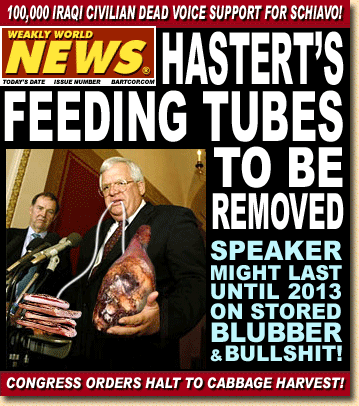
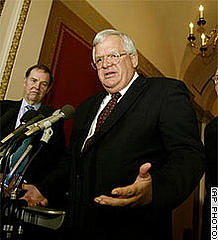
Hastert... The Sequel

Well, was the many-chinned man from Illinois fighting to preserve the Constitutional independence of Congress in railing about the Bush administration's search of William Jefferson's House office, or does he have some mixed motives here?

It was here that I suggested that Mr. Hastert didn't seem too upset until after the search was completed (even though he probably could have instructed the Capitol Police to refuse the FBI entry on Constitutional grounds), so there might have been some desire on his part to make a stink afterwards in order to deter a similar search of Republican offices.

Yes, that's deeply cynical, and I shouldn't doubt the seriousness with which Hastert has protected the institution of the House of Representatives, and I should be heartily sorry for even thinking ill of Hastert's motives, given his record of selfless defense of the rules of the House.

I should be sorry, but, darnit, it's just so difficult to be contrite in the face of this news:


The Speaker of the House of Representatives, Dennis Hastert, is under investigation by the FBI, which is seeking to determine his role in an ongoing public corruption probe into members of Congress, ABC News has learned from high level government sources.

Federal officials say the information implicating Hastert was developed from convicted lobbyists who are now cooperating with the government.

Part of the investigation involves a letter Hastert wrote three years ago, urging the Secretary of the Interior to block a casino on an Indian reservation that would have competed with other tribes.

The other tribes were represented by convicted lobbyist Jack Abramoff who reportedly has provided details of his dealings with Hastert as part of his plea agreement with the government.

The letter was written shortly after a fund-raiser for Hastert at a restaurant owned by Abramoff. Abramoff and his clients contributed more than $26,000 at the time.


(hat tip to TPMmuckraker for the above)

So, maybe the Speaker did have another reason for being upset by the Justice Department's marked disrespect for the Constitutional integrity of Congress.

Or, maybe he's a true patriot.


Yeah, right.

No amount of cynicism can keep up with the brass ones on these guys.


(graphics appreciation to bartcop.com)

Playing At "I've Got a Secret..."


... may be great fun for Bush and the legislators, but it's going to be hell for the rest of us, and perhaps sooner than we think.

One of the great fears of civil libertarians is that the gargantuan intelligence apparatus used by the U.S. to monitor the rest of the world might be turned on its own population. What only a small percentage of the population understands is that such is not just a possibility, but is happening now.

Spying on U.S. citizens without warrant is couched in Cold War terms of necessity. Doing so reinforces a belief in the public mind that the threats we face are in our very midst. This has been tried before--during the McCarthy years--when Tailgunner Joe sought to convince the public that its government was overrun by spies and fellow travelers, that communists were everywhere. Today, there has been a concerted attempt by the Bush administration to accentuate so-called terrorist cells within the U.S., often pushing prosecutions on the flimsiest of evidence--including that of a clearly mentally-ill man of Middle Eastern descent who thought he could destroy the Brooklyn Bridge with hand tools and an oxy-acetylene set.

This past weekend, the Attorney General of the United States, Alberto Gonzales, made the extraordinary statement that journalists could be prosecuted for revealing national security information:

There are some statutes on the books which, if you read the language carefully, would seem to indicate that that is a possibility. That's a policy judgement by the Congress in passing that kind of legislation. We have an obligation to enforce those laws. We have an obligation to ensure that our national security is protected.


Now, what essential has been left out of Gonzales' estimation of what is possible? The First Amendment of the Constitution. Gonzales' first obligation is to uphold the Constitution. We can't know for certain what was in Gonzales' mind when he says "some statutes," but if he is referring to the Espionage Act of 1917, he is certainly failing to take into account the legislative history of that law. Wilson's administration wanted a provision inserted into that law which would make journalists liable, but Congress refused, in large part because it feared the law would be unconstitutional with such a provision included. Journalists were not to be made "fair game."

The implicit irony in such is that the press, with only a few exceptions, has been inordinately supine after September 11, 2001. The national press--and particularly the networks and cable television--have reported on Bush's staged photo-ops as if they were genuine news, rarely even mentioning that the participants were hand-picked for their loyalty to the man, or that questioners were often coached beforehand. The press, to a considerable extent, willingly became the Pravda of our time. Even the venerable New York Times cooperated with the Bush administration's propaganda campaign to drum up public support for the invasion of Iraq through Judith Miller's uncritical and infamously credulous front-page stories about weapons of mass destruction, stories which were fed to her by administration stooges such as Ahmed Chalabi and the now-notorious "Curveball."

But, what leaks of national security information does this administration fear? Only those which show its dark and illegal side--its archipelago of secret prisons, its spying on Americans without warrant, its determination to kidnap and torture suspects with impunity, its ultimate and hidden reasons for waging an aggressive preventive war, and its apparent determination to start yet another. None of these stories have revealed either names of agents (something the administration itself has done for purely political purposes) or technical details which might threaten the lives of agents in the field, which are perhaps the only pieces of information which should not be made public in any story of government wrongdoing.

At the heart of this phenomenon, however, is a strange mass psychology. The Bush administration has done everything possible to heighten the fear of the public in order to emotionally legitimize its excesses, and to use, cynically, the general faith and trust of the ordinary person in his government. Everything is being done with the public's well-being in mind, goes the general theme of Bush administration statements. The Bush administration is keeping the country safe, and it is only through such extra-legal means that the Bushies have thwarted other acts of terrorism akin to those of 9/11.

There's just one major problem: there's no evidence of such, and even if there were, would it be worth the steady compromise and eventual destruction of the Constitution? This administration, obsessed with secrecy, executive autonomy and political advantage, has assaulted virtually every clause of the First Amendment, and now, through its Attorney General, proposes to attack what little remains of an independent press--the only means by which the public has any knowledge of what the government is doing in its name.

At the same time, the national security apparatus is being used to prevent the disclosure of administration illegality in the courts, as well. The so-called "state secrets privilege" has been invoked much more frequently than in past years, and often in cases which would expose administration wrongdoing. Although legal mechanisms exist for a judge to challenge that privilege, virtually none do.

We were set on this path by two pieces of legislation--the National Reorganization Act of 1946, and the National Security Act of 1947. These acts gave the Executive branch extraordinary powers never conceived of by the framers of the Constitution, powers which have been consistently abused by the government to avoid detection of its illegal behavior. These laws effectively began the Cold War--and the transformation of the country from a democratic republic to a national security state--and successive legislation has further eroded the public's right to know.

In a way, the Bush administration is a symptom of the national security state, rather than its cause. Bush and Co.
have simply used the system provided them in ever more creative ways than their predecessors. The immense power of the official secret bureaucracy is now used to quash lawsuits which would reveal government wrongdoing, to intimidate journalists desiring to expose wrongdoing, to violate fundamental tenets of the Bill of Rights, to protect war profiteers friendly to the administration from public scrutiny, and to actively prevent the public from questioning the legitimacy of the government's actions through propaganda campaigns.

There is a delusion on the part of the public today which is partly responsible for the government's actions. Because of a fear largely enhanced by the government itself, the public believes it is under constant assault and wishes protection from the very fear generated by the government. At the same time, because the public can travel (more or less) freely within our borders and sees no overt signs of martial law, it believes that it is both safe and free. And yet, is anyone free that does not have the absolute rights guaranteed by the Constitution? Almost by definition, no.

But, the public's general attitude seems to be that if it's not out in the open to be seen, it doesn't exist (call it the Ostrich Principle). For that reason, there are questions which should be asked, frequently and loudly:

  • First, does the national security state actually protect us from harm? (The fact that 9/11 occurred suggests that it does not.) If it does, is the harm prevented greater or lesser than the harm created by the loss of our civil rights?
  • What becomes of our society as the tools and tradecraft of spying on the rest of the world are gradually turned inward, on us? (This has happened in the past and is happening again, now.)
  • What is the end result of a courts system which either willingly or indifferently does not restrain the Executive branch's illegality?
  • What is the end result of the administration's intention to suppress public knowledge through the intimidation of the press?
  • What is the end result of this administration's determination to ignore law through the extra-legal process of signing statements and the perversion of the Executive Order?
  • What is the end result of a partisan Congress working in concert with an administration determined to act illegally and unconstitutionally?
  • What becomes of the United States, internationally and domestically, if this administration increasingly militarizes intelligence operations, as it is now doing?
  • What happens to the public's ability to discern the truth when the information it receives is increasingly polluted by government propaganda?
  • What happens to the country if we continue to spend far beyond our budget for military and intelligence functions which are increasingly used domestically? How are we affected, as a society, by the increasing privatization of these functions?


Because all these things are in process now, it's legitimate to ask what becomes of the country if they all proceed to their logical ends. The answer, of course, is simple. We will have, at best, an authoritarian government using bureaucratic power to enforce repression.

At worst, we may become an ideological dictatorship hidden by a thin veneer of democratic institutions, most of which may serve only symbolically.

Therefore, the last question to ask is very simple. Who benefits by this ever-accelerating government secrecy? If the Constitution vested the people with power over the government, does greater and greater government secrecy improve the people's control over that government, or does it improve the government's control over them?

Tuesday, May 23, 2006

Too Funny for Words...

... well, that would be Dennis Hastert, it would. The tubby fellow from Illinois (R-Nouveau Riche) takes umbrage at the FBI raiding the offices of a Democratic House member in a bribery/influence peddling/corruption case.

Will wonders never cease. Of this affront, Hastert is quoted as saying:

"The actions of the Justice Department in seeking and executing this warrant raise important constitutional issues," House Speaker Dennis Hastert, an Illinois Republican, said in a statement last night. "I expect to seek a means to restore the delicate balance of power among the branches of government that the founders intended."

This is a bit like Lucretia Borgia whining to the waiter that the wine was corked.

Hastert went on to say, "since the founding of our republic 219 years ago, the Justice Department has never found it necessary to do what it did Saturday night, crossing this separation of powers line in order to successfully prosecute corruption by members of Congress."

Well, the man from Illinois with the many chins failed to add that he and fellow conspirator, Tom DeLay, had done everything possible to prevent adequate oversight by the House Ethics Committee, up to and including introducing new rules preventing the removal of DeLay from his Majority leadership after his indictment.

What Hastert did not say was that the execution of this search warrant scared the livin' bejeebus out of him and all the other Republicans who've had their hands in the cookie jar since they took over the House in 1994.

What Hastert did not say was, "holy shit, that could have been _my_ office they're searching. They might have found all those thousands of $198 checks from the Turkish-American Friends Society." Or, something like that.

What Hastert did not say, but was thinking, "now, thank goodness, ethics are the Democrats' problem, but I'll bitch about this after the warrant is executed, so maybe they won't do it again with us."

What Hastert did say was, "I expect to seek a means to restore the delicate balance of power among the branches of government...." What Hastert meant to say was, "... now that Jefferson's chops are in the frying pan."

Delicate balance? What delicate balance? What's been going on for the last near five-and-a-half years has been nothing but the Ballet of the Steamrollers. George Bush want, George Bush say, Congress do. War, destruction of civil rights, tax cuts for the Westchester set, an energy bill that converts money to pork, a Medicare drug plan that's under-the-radar privatization and a gift to Big Pharma? Bring `em on--get those steamrollers in here!

Lies about war, lies about destruction of civil rights, lies about tax cuts, about Medicare, about Social Security, about fatcat contracts to the Vice-President's friends, outright gifts of taxpayer funds to oil companies making record profits, oh, no, get them steamrollers outta here, now! Denny Hastert running from the podium [well, the pork-loving, waddling equivalent to running], screaming, "Weeeeeeeeeeeeeeeeeeeee don' wannnnnnnnnaaaaaaaaaaaaaaa knooooooooooooowwwwwwwwwwwwwwwww...."

Attention! Attention! Brain-dead woman available for political exploitation. Get her on the steamroller, tubes and all, and get that President back from that vacation abyss he's been on--there's political work to be done in this here House!

Delicate balance? Between what and what? This Republican Congress has been a juggernaut of corruption and a rubber stamp for Bush and for anyone with big money to spend for years, and suddenly, Dennis Hastert is concerned about the integrity of the institution?

Too friggin' funny for words.

Sunday, May 21, 2006

The Question We're All Asking Ourselves...

...is: will we live through this shit, or not? Have these last few years been the thin edge of the wedge? Can we expect future stolen elections and more of the same? Basically, all our questions come down to the same thing: are we well and truly fucked?

In so many ways, I feel as if my life is in suspended animation, that I'm waiting for some sign that it's over, that everything will get back to normal, and yet, the signs I see are diffuse and indistinct, like traffic lights in the fog. Is that really red, or is it amber? It don't look fuckin' green to me, bro'. No one can tell.

Even if Karl Rove is indicted, will it stop the cretin? I often think, if indicted, he'll just resign from the White House and go to work for the RNC, where they'll install a hot line in his office directly into Dubya's brain. Instead of being down the hall, he'll be down the street. The miracle of modern communications will prevail.

It's a sign of desperation that we think it should be like it is in the movies. We don't need one of Jimmy Stewart's Mr. Smith in Washington, we need 535 clones of him. Fat chance of that happening, you say. Me, too. The press is like "All the President's Men," yeah. Ha. Not even close.

It's not even fun to say, "Toto, we're not in Kansas any more," because even that's a bad joke--no one sane wants to be in Kansas, any more. Kansas is fundamentalist death on a cracker, these days. Fred Phelps and his partners in moral crime think Toto is a fag. Fred Phelps thinks everyone but him is a fag. There's some weird psychopathology there, mind you. Might even involve Toto. Most of the rest of Kansas thinks Bush would be just fine with them, if he were just a bit more like Eisenhower. Maybe if he had a little less hair.

But, I dunno. I don't. The problem I have is the same one most of the rest of the country has--how do we actually know what's going on? We don't, and it's driving us all nuts. We're supposed to be living in a free, open society, and we don't have a fuckin' clue. None of us ordinary schmos know what's happening. Not a one of us. I sometimes think I know some of it. I think I get a glimpse or two behind the curtain, every now and then. Then, it all goes to dark and I'm left holding my putz and wondering what the story was all about.

We grasp at any straw, any sign of sanity, and, poof!, it's gone again. It's all so... squalid. That's the best word I can come up with right now.

Pat Roberts (Gen. Hayden's alter ego) says some very Constitutionally-suspect programs have prevented acts of terror. How do we know? That the CIA says so? That Kindasleezza says so? The word "credibility" isn't in their resumes, nor their characters. How many al-Qaeda #2s and #3s have we captured so far? Do we know they've been captured, for sure? None have come to trial. There's no way of knowing if they're getting bleach poured down their throats in the dank basement of some Bulgarian shithole, or if they're playing cards in a tea room in Cairo. We just don't know.

What we do know is that there is not a single Bushite that can tell the truth about anything. Not a single goddamned thing. Ask Donald Rumsfeld what he had for breakfast, and he'll lie about it--just as a means of staying in form.

Bush himself started lying the moment he learned to talk and has been doing it ever since. None of that would matter, except that he did it all the way through the 2000 campaign, and the press smiled and said, "but, Al Gore is the biggest phony in the universe. And his mother dresses him funny."

Maybe what I'm getting at here is that the country has gone nuts--completely starkers. And, it's catching just to live in a society where people actually pay attention to religious loonies like Pat Robertson and Jerry Falwell, where a shark attack or a missing blonde girl gets 4000 hours of network coverage, but a story about the government spying on everyone in the whole friggin' country gets two column inches in the local paper and a 6-second non-denial denial on network news from a Bushbot, which is treated by the press as God's law come down from the mountain.

Here's just a guess about all this. If the public actually knew all of what this bunch of moral lepers in the White House were up to, it still wouldn't make much difference. It would really have to be something big to get the public's attention for more than five minutes.

"Hey, the news ticker on Fox says that Condoleezza Rice just turned into a five-foot tall cockroach and she's changing her name to Greg Sam-something."

"Yeah? Cool. She should go on American Idol."


"Whoa, Karl Rove's head exploded and there are all these tentacles slithering out of the stump of his neck!"

"Way cool. John Carpenter made a movie of that, didn't he?"


"Hmm. Just saw video of George Bush screwing a chicken on the Truman balcony."

"Poor dear, he's been under a lot of stress lately."


"Bill O'Reilly just said we should all boycott Namibia."

"That's okay, dear. I only buy Prego, anyway."


"Tony Snow just pulled out an M-16 and shot Helen Thomas about twelve times."

"Serves her right. I don't know why they let an Arab terrorist in the White House in the first place."


"Uh, Mildred, there are a whole bunch of tanks coming down the street."

"Maybe they're going to the Gomez's house. Never did like them."


"That was your mother on the phone. They just took your Uncle Harold away."

"I told him he was a damned fool for carrying that stupid sign around."


"Your picture looks real nice on your national identity card, but it didn't turn out too good on your travel permit."


"News article here says the police arrested over 300 undesirables over the weekend. Eighty drug dealers, fifty people wanted on outstanding warrants, twenty animal rights activists, sixty-three people for trying to register voters, twelve college professors and seventy-eight assorted communists, homo-sexuals and leftist types."

"I'm sure they'll all get a fair trial."


"George Bush just launched a buncha nucular missiles on Moscow, and Paris, and Berlin, and Tehran and Beijing and Caracas and the UN building in New York!"

"Hope John Bolton gets out of there okay... do we still have time to get to the mall?"


It could be worse, though.


Rick Santorum could be the second Messiah. Then we'd know for sure that we were all fucked.


Saturday, May 20, 2006

A Few Notes of My Own...

... on nationalism, with some help from DeToqueville. In a few recent blog entries, I've been citing George Orwell's "Notes on Nationalism," because some of his thoughts apply to the United States today, even though he was writing of the English intelligentsia at the time of the end of WWII.

Good explanations for American nationalism can probably be found in Alexis DeToqueville's Democracy in America, first published in 1837. It was in that volume that DeToqueville coined the term "American exceptionalism," that democratic rule was the unifying force in the America of the time, and was the force which would propel it to the forefront of history. It is this notion of DeToqueville's which has been seized upon by current nationalists, while some of his lesser aphorisms and observations on America go unnoticed or ignored. It's likely, too, that the America with which DeToqueville was familiar suits current nationalists and Republicans. That America was democratic, but not for all. In 1837, those who could participate in democracy, who could vote, or be elected to office, were overwhelmingly white, male and possessed property.

What unified and drove Americans, though, was not so much democracy as profit (think of democracy as a vehicle and profit as the destination). Of this, DeToqueville said: "As one digs deeper into the national character of the Americans, one sees that they have sought the value of everything in this world only in the answer to this single question: how much money will it bring in?" While it is now fashionable to quote Ben Franklin in his role as a commenter on the Constitutional Convention ("You have a Republic, ma'am, if you can keep it"), most of Franklin's thoughts ran to the subjects of thrift and profit--indeed, much of Poor Richard's Almanack can be thought of as the investment tips newsletter and the Seven Habits of Highly Effective People of his day.

What DeToqueville was hinting at was that democracy was a great tool for the merchant class, which had been transplanted to America from Great Britain--that merchant class could make its own rules about taxation, about transfer of goods across state and international borders (that Commerce Clause of which so much has been made of today), in short, that it could tailor its government to its primary interest, profit. It could, at the state level, create corporations and then, at the federal level, tax them (or not tax them) and/or subsidize them according to the desires of those who would most benefit. Those interests were very often represented by their own Senators and Congressmen and judges.

Some the earliest crises in the new government stemmed from such desires to use government for private and party gain. Adams and Hamilton edged government toward the service of the aristocratic right, mistrusting the "rabble," by getting the Alien and Sedition Acts of 1798 passed. Adams used the threat of war with France to increase the power of the Federalists and to squelch anti-Federalist public opinion. Behind it all was the desire to consolidate the power of wealthy New York mercantile and banking interests and to minimize the power of the Southern agricultural centers.

Likewise, events which led to the censure of Andrew Jackson pitted the Northeastern banking interests against the Southern agriculturalists because of Jackson's determination to thwart the establishment of a second Bank of the United States.

Almost from the beginning of the government, the desire to use that government to obtain larger and larger slices of the available pie was virtually unrestrained. While there was a moral component to the Civil War with regard to slavery, economics played a strong role in the reasons for the war. Northern manufacturers were unhappy with the premium prices charged by the South for cotton. Once the war started, those manufacturers used their banking power to buy cotton from Egypt (the price of Egyptian cotton rose 50% during the four years of the Civil War) and the devastation of that war ensured the near-term political and economic dissolution of the South. Northern manufacturers, having established a secondary source of cotton during the war, could then set prices after the war, and once again act as internal colonialists, obtaining raw materials from the South at bargain-basement rates and returning finished goods to the South at premium prices.

From the start, no one particularly minded territorial expansion, because there was money to be made. Jefferson was not particularly excoriated for essentially making his own deal with the French in the Louisiana Purchase, even though Congress had been pretty much left out of the negotiations. Monroe's Doctrine regarding the western hemisphere would put the rest of the world on notice that America had expansionist ambitions, and no one was fooled by the religious component in the concept of manifest destiny. It was all about money. Zachary Taylor's incursions into Mexico were generally applauded, and paved the way for the annexation of much of the West. Commodore Perry's first trip was hailed in the press for opening relations with the inscrutable Orient. On his second trip in 1854, he used the threat of military attack on Japan's capital city of Edo to force the Japanese to sign a very disadvantageous trade treaty. By 1868, that treaty had destroyed Japan's economy.

By the 1890s, the robber barons of the United States had their sights set on Latin America, and particularly, China, and despite all the talk then about God's will and divine duty, the real reason was, again, unrestrained economic rapaciousness. During debate, Sen. Albert Beveridge of Indiana seemed to let the cat out of the bag, saying, in promotion of the Spanish-American War in 1898, that it was "the mission of our race, trustee under God, of the civilization of the world" and as if to reassure the business community, went on to remind his colleagues and the public of "China's illimitable markets... just beyond the Philippines."

As in more contemporary politics, Beveridge's century-old moral protestations only thinly disguised the underlying reason for war. Some, perhaps Beveridge's friends and contributors, were going to make themselves a figurative killing on the literal sort.

And here is where yet another of DeToqueville's lesser observations has been ignored: "All those who seek to destroy the liberties of a democratic nation ought to know that war is the surest and shortest means to accomplish it." And yet, some Americans had discovered that war was very profitable--as long as the costs of war were borne by all the taxpayers, while the profits were divided among the few. DuPont, largely family-owned at the time, saw its profits soar from $6 million a year before the beginning of WWI to $60 million during the war, thanks to the sale of one of its products--explosives.

It is in the context of this past that today's nationalism makes more sense. Corporations now effectively control the political process--mostly by using campaign money and lobbyists' largesse to gain access to politicians--because the government was set up to enable businessmen to set their own rules of conduct and rates of taxation, and multinational corporations are the inevitable legal outgrowth of the desires of the early merchant class to be rid of King George's levies on their profits.

Similarly, racism and sexism are necessary components of nationalism today--in part because the democratic system in place in 1783 was meant to be moderately exclusive. That limited the shares of the pie. Nationalists today are generally in favor of any action which continues to limit those pie shares--whether of the energy pie, the economic pie, or the international political pie.

Religion, too, is today an essential feature of nationalism, for it gives moral justification for all manner of immoral behavior in the pursuit of profit. Many today wonder how the teachings of Jesus can be warped to the obviously mercenary ends of the modern Republican Party (due in large part to modern marketing techniques being employed in the cross-branding of popular Christianity and Republicanism), and yet, the answer can be found in the origins of the country. Current authoritarian attempts to regulate all manner of social behavior (particularly with regard to reproduction) are grounded in Puritanism, which sought to regulate behavior toward a specific end--economic efficiency. Equally, much of the justification for acquisition of wealth, contrary to Jesus' teachings, can be found in the modern-day equivalents of Calvinism.

The uniformity of thought of current-day nationalists was also anticipated by DeToqueville: "In the United States, the majority undertakes to supply a multitude of ready-made opinions for the use of individuals, who are thus relieved from the necessity of forming opinions of their own." Modern communications and public relations have turned this process to a near-art form, but the roots of this conformity of thought have been around for some time. Thus, the contemporary nationalist has a uniform body of thought on which to draw which employs traditional stock-in-trade terms such as "freedom" and "spreading democracy," the meanings of which have become distorted over time by rampant profit motive. In this sense, DeToqueville foresaw the ability of the few to convince the many that the aims of the few were universally held, even when those aims were not of benefit to the many.


Even so, while much of the country's history has been rooted in the quest for profit and the unbridled acquisition of wealth by the few, the founders did an interesting thing--they offered up a body of law which put people's interests in tension with the interests of government and which was capable of amendment. For those reasons, current nationalists seem most offended by the changes wrought in the amendment of that law--women's suffrage, the emancipation of slaves, the equal rights of all explicit in the 14th Amendment and the multiculturism implicit in that change.

Equally, current nationalists find pleasure in one-party rule, with Congress limiting its own power and deferring to that of an all-powerful Executive whose programs of perpetual war, economic elitism and imperial expansion serve the interests of unrestrained capitalists. In that, DeToqueville was prescient: "The surface of American society is covered with a layer of democratic paint, but from time to time one can see the old aristocratic colours breaking through."

After over two hundred years, the aristocracy of kings was broken, and by virtue of self-rule, a new paradigm was promoted, in which were set the rules by which a new aristocracy of entitlement by wealth would be created, which has, in turn, brought about an outcome which was inevitable, given the country's beginnings--the establishment of a government with all the outward trappings of a democracy, but with the inner workings of an oligarchy which uses the power of government to further enrich itself and consolidate its power in government and in society.

And, in that, too, DeToqueville saw further than most with regard to America's future: "We succeed in enterprises which demand the positive qualities we possess, but we excel in those which can also make use of our defects."

One of those defects, exhibited by so many nationalists today, is that we are easily led in directions we should not go. Only now, after twelve years of a dedicated Republican effort to corrupt Congress and five years of Bush's autocratic approach to governance, the spectre of all-encompassing electronic surveillance beyond public control and the prospect of neverending war, accelerating debt and our diminished status among international friends and adversaries alike, do we even begin to see that error discussed in the public square, and then, haltingly.

Such is the collective power of the voices standing proxy for that new oligarchy. Even in this, DeToqueville could see the inherent problem: "
In America the majority raises formidable barriers around the liberty of opinion; within these barriers an author may write what he pleases, but woe to him if he goes beyond them."

The task today, then, is to expose the current "majority" for what it is in actuality--a minority of extreme nationalists in service to what FDR accurately defined as "the malefactors of great wealth."

Friday, May 19, 2006

"People are unsettled," Bush pronounces...

... and David Gregory tried to inject a little reality into an interview Bush gave him while touring the border. The transcript went like this:


GREGORY: Let me ask you about your leadership. In the most recent survey, your disapproval rating is now one point lower than Richard Nixon’s before he resigned the presidency. You are laughing.

BUSH: I’m not laughing--

GREGORY: Why? Why do you think that is?

BUSH: Because we are at war, and war unsettles people. Listen, we got a great economy. We’ve added 5.2 million jobs in the last two and a half years. People are unsettled.

GREGORY: But they’re not just unsettled sir. They disapprove of the job you’re doing.

BUSH: That’s unsettled.

No, George, unsettled is Grandma's state of being when needing a little extra Metamucil.

Unsettled is how you feel watching your thirteen-year-old perfectly lip-sync Jessica Simpson songs.

Unsettled is your mood when getting onions on your burger after saying, "no onions," twice.

Here's how the Random House Unabridged defines "unsettled":

1. not settled; not fixed or stable; without established order; unorganized; disorganized: an unsettled social order; still unsettled in their new home.
2. continuously moving or changing; not situated in one place: an unsettled life.
3. wavering or uncertain, as in opinions or behavior; unstable; erratic: an unsettled state of mind.
4. not populated or settled, as a region: an unsettled wilderness.
5. undetermined, as a point at issue; undecided; doubtful: After many years the matter was still unsettled.
6. not adjusted, closed, or disposed of, as an account, estate, or law case.
7. liable to change; inconstant; variable: unsettled weather.

I'd presume that def. 3 is the one Dubya had in mind, although def. 7 might more accurately describe the American public on many issues. Nevertheless, none of them apply to the actual matter at hand. A majority of the public are now decidedly not unsettled in their opinions of the Wanker-in-Chief. About 70% of the public no longer like this man for one reason or another. They don't trust him. They don't like the direction he's taking the country. They think he's doing a lousy job. Some of them think he stinks to high heaven. Some of them think he's a raving lunatic. Some even fuckin' hate him. No small number want him impeached. Some of those want him impeached and thrown in the clink for war crimes.

Bush gives the Iraq war as the reason for that "unsettled" public mind, and yet, it is precisely the war and Bush's duplicity about that war--about its conception, its gestation and its aftermath--that has gelled and hardened people's attitudes toward Bush. Some of those Bush critics are certainly upset because there was no clear-cut win for the home team. Most, however, have come to the certain and unshakeable conclusion that they were manipulated and misled by Bush and Co. into supporting an unnecessary war which has resulted in the loss of much blood and treasure, with no end to those losses in sight.

What's behind this "unsettled" business? More of Bush's intractable tendency to inflexibility of thought? More unwillingness to acknowledge the obvious? Bush's increasingly obnoxious inability to admit a mistake? After all, Gregory asked the question precisely because of those known tendencies of Bush to embrace the bubble-boy syndrome.

All those Bush attributes figure into it, but the root cause may well be that Bush doesn't really care what the public thinks of him. The Bush White House has stated from the start that it doesn't pay attention to polls, and this may actually be true, in one sense. Rove and the political arm of the White House do, in fact, pay very close attention to polls, but mainly for testing which words work, and which do not. The message constantly changes according to those results, but the underlying politics are exactly the same--we do what we want, when we want, and the public be damned. Polling serves only to adjust the message, to disingenuously maximize positive public opinion for what are, in fact, highly elitist and exclusionary policies.

The current problem for Bush--according to conventional wisdom--is that the public is no longer buying any of the messages. The news from Iraq is bad, and nothing Bush can say can change that--even his repeated assertion that the media is concentrating on the bad and not accentuating the good. The reason for that is simple--Americans like short, quick wars in which the U.S. wins, decisively, and every day that does not happen reinforces negative public opinion. Vietnam is a model for that circumstance. Between Afghanistan and Iraq, the U.S. has now been at war, occupying those two hostile countries, for almost fifty-six months, nearly a year longer than U.S. involvement in WWII.

Two things have mitigated against any real improvement in the way the public thinks of Bush--his pronouncements that the "war on terror" will go on indefinitely, and his statement that withdrawal from Iraq will be a problem future presidents will have to solve. Bush, himself, has told a public wanting a short war that this will not be a short war. The public reaction to such pronouncements is predictable.

Bush has a marked tendency to reduce all argument to contradiction, thus using the power of his position to "win" the argument--to be the last person to say, "is so." The public will have to live with that for a while longer, but they won't be liking it. Bush knows, though, that in his world, what they think doesn't matter. As long as he's in office, his friends are getting very, very rich, and he knows that their appreciation will accrue to him after he leaves office, as was the case with his father before him. It should be the Bush family motto: "Public Service for Private Gain."

Remember what Bush said to Bill Hangley, Jr., on the 4th of July, 2001: "Who cares what you think?"

The wars go on because they're very profitable for some in this country. That may even be one of the strongest reasons to expect an attack on Iran. The public may know that, by now, but it doesn't matter what they think. They won't be putting easy money in Bush's pockets after he leaves office in 2009. Every decision Bush has made has money in mind, whether that be campaign money, or profits for his base. The benefits will eventually accrue to him. Even so-called immigration reform will mean billions of dollars in taxpayer-funded receipts for the government contractors and stockholders who are the intended beneficiaries of any Bush program.

Bush has needed the public for one thing, and one thing only--its votes. That's the only opinion of the public he's ever cared about. If they no longer think so well of him, that their opinions are "unsettled" to him, still and all, those opinions are of no further interest to him. They thought well of him in November, 2004, and that is all that has mattered. The voters have already made their contribution to his retirement fund.

Occam's Razor, simplified, says that the most direct and simplest solution to a problem is most likely to be the right one. The psychology of Bush's indifference to public opinion is likely complex, impinging on many different pathologies, and some of those analyses may provide some insight into his character. But, the simplest answer is that the public is no longer of any use to Bush. After a life spent in service to one's self and one's cronies, public opinion is something to be used, not respected, and to be dismissed when it is no longer of any use. There's now no logical reason to expect from Bush anything other than indifference. Bush was laughing and smirking. Who cares what you think?

Thursday, May 18, 2006

Bush Is Just Doing a Little Border Brush Clearing...

... and all those who previously thought him a genius now believe they are smarter than he is. Monday night's immigration speech seems to have brought out the unhappy souls in Bush's base.

Now, none of them actually said they were unhappy because Bush didn't announce that National Guard troops would be machine-gunning Mexican border crossers on sight, but the despair at his proposals suggests that Bush's base was expecting something, uh, um, more, uh, yeah, macho.

Maybe this all comes back to Bush's claim that he's a Texan through and through, and his young devotees thought him a _traditional_ Texan, one who knows a wetback when he sees one and what to do with such riffraff.

And, now, they're sure they're smarter than George. Smarter than Rove, even. Even funnier, they don't like that situation all that much. The more rabid and less intelligent among Bush's base know something's wrong with their prior evaluation of him, but they can't quite deconstruct the contradictions in their previous support of their DEAR LEADER.

Maybe, it's because none of them has yet found an image of Bush on a grilled cheese sandwich.

Or, maybe, they haven't been thinking this business through because they're just reacting and running scared. Maybe, this issue of immigration has never been about what they wanted, but, rather, about how they and their idiot friends in the Minutemen could be used for the purposes of Bush's real base--the haves and the have mores. Nothing new in that.

At the heart of the matter is not the question of amnesty, as so many have claimed. The real concerns of the right are racial. The House's latest insanity enshrined in legislation requires illegal immigrants to face felony charges for entering the country illegally. Few people are noting this, but if one is a felon, one can never, in practical terms, be considered for citizenship, and the likelihood of later obtaining even a green card is extremely low if one has been previously convicted of a felony, especially of one in this country.

This legislation, on one level, is intended to work much like the drug laws, which disproportionately affect people of color. Combine those laws with existing laws in many states stripping felons of their right to vote and there's a ready-made means of keeping brown people politically powerless. Whiteness prevails through righteous indignation. The current House immigration bill would accomplish much the same thing by denying any future opportunity to vote by any of those now in this country illegally for simply economic reasons.

However, lurking beneath the bonehead right's pasty-faced fear of being outbred is profit motive. There may be no overt attempt to follow through on such while the House immigration bill is still in contention, but there are subtle signs that money is on some people's minds. Many people were very concerned with the "detention centers" for which Halliburton received an open-ended contract worth as much as $385 million. That contract was let a number of months ago, and very quietly. Now, we find that Rep. James Sensenbrenner (R-koTex), the sponsor of the House immigration bill, had been in negotiations with the White House on the bill as far back as last September, and that he's miffed that Bush has reneged on the felony requirement that Bush once backed.

Now, follow me here--it's not a difficult train of thought. There's a reason in making felons of illegal Mexican immigrants to deny them any future possibility of becoming citizens and, therefore, voters in this country, but... no one makes any money off that. In fact, business loses plenty of low-cost labor, which ordinarily helps it to depress wages generally. Is it possible that what is ultimately desired is to incarcerate illegals in these special detention centers, hold them for a year or two of their felony sentences and then deport them, and use them as low-cost labor during incarceration, all at federal taxpayer expense? It might seem outlandish, but for the comments of Rep. Dana Rohrabacher (R-Californication) in April when he was asked about not having the necessary workers around if the U.S. deports them all: "...the millions of young men who are prisoners throughout our country can pick the fruit and vegetables. I say, let the prisoners pick the fruits..."

Typically, prisoners in prison work programs make a buck an hour or less, while the prison system charges business minimum wage for their labor, taking the difference for prison operation. Lessee how this might spin out...

  • A company specializing in privatized military construction and services gets a federal contract to build detention centers around the country for ill-defined purposes (spokespeople vaguely mumble about "immigration emergencies"). This has come to pass.
  • A few months later, House right-wingers are determined to pass a law making illegal immigration a felony. Felons would go to jail... or perhaps, to federal "detention centers," and be deported after incarceration. This is in process.
  • Batshit-insane representative from California makes non-sensical statement about using prisoners for farm labor and everyone ignores him. Does he let cat out of bag?
  • House version of bill prevails through skullduggery in conference. Bush complains mightily, threatens veto, then signs bill. (An oh-so-shopworn routine, by now.)
  • First detention centers hastily completed in and around the agricultural areas of California and the Southwest. Halliburton receives contract to run detention centers, subcontracts inside guards and staff from Corrections Corporation of America, subcontracts perimeter and work gang guards from Blackwater.
  • National Guard ordered to begin sweeps through cities looking for illegal aliens in cooperation with INS and Border Patrol.
  • Federal courts are swamped with felony immigration cases, so the law is amended to put cases in front of quickly assigned INS administrative law judges. Minimum sentencing requirements apply.
  • First large corporate farms in California make contracts with Halliburton to supply prison labor for farm work at $5.15 per hour, several dollars less per hour than through the United Farmworkers. Prisoners begin to appear in fields around Fresno.
  • Costs soar in immigrant detention program. Congress passes supplemental off-budget funding to keep program alive.


Far-fetched? Maybe. A lot of things that seemed damned near impossible before the Bushies came to power have, indeed, come to pass. Parchman Farm, meet the CEO President and his sidekick, the KBR Kid.

The Latest Three-Minute Hate...

... announced by the right-wing blogosphere seems to be the attacking of John Murtha for his daring to suggest that an occupying army's killing of unarmed civilians--including children--might be viewed as murder. That the military lied about it afterwards only compounds the problem.

From the evidence available, U.S. Marines entered Iraqi homes on Nov. 19, 2005, and indiscriminately killed fifteen people, some execution-style. Yesterday, MSNBC reported:

On Nov. 20, U.S. Marines spokesman Capt. Jeffrey Pool issued a statement saying that on the previous day a roadside bomb had killed 15 civilians and a Marine. In a later gunbattle, U.S. and Iraqi troops killed eight insurgents, he said.

U.S. military officials later confirmed that the version of events was wrong.


Unclaimed Territory has a sampling of the comments about and punishments of Murtha (and the press) suggested by the whitey-tighties on the other side of the cyber-aisle.

It seems that there are a number of undercurrents to all this screaming "traitor," and I doubt that we're ever going to find where each of them leads. But of one thing, I am quite sure. Part of this insanity stems from people who weren't even born when the war in Vietnam was concluded, but feel that their voices, then as now, to stay the course and show some "patriotism" would have turned the tide, that the United States was right, and defeat came because of a failure of will. That the United States, its military and its leaders are so noble of purpose that only subversive erosion from within could account for the U.S. losing anything.

Implicit in that notion, lurking in the background, unspoken, is also the belief that the U.S., being perfect, has the right to behave as inhumanly as necessary in order to win, and that the ethical foundation that means and ends are inseparable is, in itself, subversive.


The similarities of Iraq to Vietnam are occasionally overwrought. But, in this instance, there's merit to the argument, I think. The Marine unit carrying out this wholesale execution of civilians had previously lost personnel to insurgents. They were frustrated by an inability to discern civilian from guerilla fighter. They were not adequately trained for the tasks they'd been ordered to do. They wanted revenge, nothing more, nothing less.

Exactly the same conditions set the stage for the horrors of My Lai. And, exactly the same thing happened after My Lai. The military covered up the true nature of the crime.

The 11th Infantry Division had been poorly trained, and its ranks were filled with the dregs of the military, along with a large complement of young officers who'd just finished OCS and were without the leadership skills necessary to keep a tragedy like My Lai from occurring. Almost from the moment it had been dropped into the Vietnamese countryside, the 11th had taken heavy losses. They blamed the deaths of some favored comrades on the village of My Lai. Had it not been for a young investigative reporter by the name of Seymour Hersh, the military might well have been able to bury the story, just as the Marines attempted to do with the killings in Haditha.

What Hersh essentially said in his reporting was that the war had not only turned sour, but that the American military's response to diminishing returns had been to turn ugly. The exposure of the truth of My Lai, in part through the efforts of the recently-deceased Hugh Thompson, a helicopter pilot who interposed his craft between civilians and the infantry of the 11th and ordered his crew to fire on any soldiers attempting to kill more civilians, was a shock to the public.

It was a shock because the raw, naked truth of those hours of inhuman slaughter were at such enormous variance with the popular beliefs held by the public--about their military, about themselves and about their leaders. Those popular beliefs were, and still are, very powerful, but contrived, images about our perceived rectitude in all things, and of the identification of the public with the country's military, to a degree which can now be reasonably assessed as unhealthy for a free society.

Of this sort of nationalism, George Orwell wrote in 1945:


... although endlessly brooding on power, victory, defeat, revenge, the nationalist is often somewhat uninterested in what happens in the real world. What he wants is to FEEL that his own unit is getting the better of some other unit, and he can more easily do this by scoring off an adversary than by examining the facts to see whether they support him. All nationalist controversy is at the debating-society level. It is always entirely inconclusive, since each contestant invariably believes himself to have won the victory. Some nationalists are not far from schizophrenia, living quite happily amid dreams of power and conquest which have no connection with the physical world.


Hence the interminable attacks on anyone--Murtha, investigative journalists, bloggers--who present a different (and, likely, more truthful) reality from the one favored by the right wing in this country. At the heart of it all is a blind nationalism. If an inconvenient truth somehow bubbles to the surface, the truth-teller must be punished--for the crime of trespassing on the property of the fervent nationalist's fantasy world--for the felony of bubble-bursting.

Here, perhaps, is a fundamental conundrum of politics today in these United States. The founders acknowledged that a free and informed citizenry was essential to the health of democracy. That is why freedom of the press was guaranteed in the Constitution's First Amendment. A substantial number of people still believe in knowing what the government is doing in their names and expect--demand--that the press honor its obligations to that end. At the opposite end of the political spectrum are a substantial number of people who don't want to know what the government is doing, for fear that such knowledge will challenge--or utterly destroy--their carefully constructed world, in which the United States, its military, its political leaders and they themselves are pure, perfect and infallible.

This, too, may partly explain the unwillingness of that latter group to enthusiastically join the military in time of war, even as they revel in war. Military life and day-to-day operations in an occupied country would constitute a different reality from the one they have constructed about their country and its military, and it might force them to acknowledge truths--about their country and about themselves--which they are now safely free to ignore.


Tuesday, May 16, 2006

Why Am I Not Surprised?


Arlen Specter. Rather, Arlen F.ucking Specter. Noted and esteemed Senator from the often less than great state of Pennsylvania (yes, I know, Pennsylvanians will think that grossly unfair, but you've sent our Senate two putzes for far too long--do you keep electing Santorum to make Specter look good by comparison?).

Specter has been running to the cameras, wattles all aflutter, to denounce the Bush White House on domestic spying, promising action, and often hinting at retribution. Then, quietly, when the lights are turned off and the news flacks go home, he sits down with the rubber-stamp right wing on his Judiciary Committee and gives up. When Alberto Gonzales came to visit a Specter hearing, oh, no, no oath for him (all prearranged, judging by the way the Democrats' request to swear in the Texas Toady was ignored). Gonzales bobbed and weaved and basically told Specter's committee, "fuck you, we do what we want."

Barely two weeks ago, Specter threatened to cut off funding for Bush's domestic spying program, saying in an interview: "We have a Congress which candidly is more concerned about re-election and fundraising and who controls the House and the Senate than in asserting constitutional prerogatives. That's not the way it ought to be."

Brash, bold, forthright. Just the kind of talk the country needs in perilous times, right? Well, yeah, except that it's only talk. Today's issue of The Hill fronts this story. Not only does Specter's cave-in pave the way for Mike DeWine's bill to make the illegal legal, but Specter's "compromise" bill sets standards for standing (the proof necessary to show injury by the government's actions) which will facilitate government stonewalling in any case brought under the law. The Hill's story at a couple of points mischaracterizes the issue of standing, as both Glenn Greenwald and the Anonymous Liberal point out here and here.

A tangential effect of Specter's "deal" (in truth, it can hardly be called even that, since the agreement Specter made benefits only one party--George Bush) is that there likely will be no further Judiciary Committee hearings of substance on the real issue at hand--persistent and longstanding illegal acts by the White House.

In 1974, when the excesses of Richard Nixon were being hammered almost daily, it was Howard Baker, a loyal Republican, who sighed and said enough is enough, and asked the question that would eventually be the defining moment marking the beginning of Nixon's political end: "What did the president know, and when did he know it?" Baker understood what was at stake. Baker asked that question of John Dean, Nixon's White House counsel, who was under oath. Baker was willing to co-chair the Watergate special hearing in concert with the Democratic Chairman, Sam Ervin. He was willing to make that Senate Watergate hearing proceed, often agreeing to use the subpoena power of the committee, despite the sure knowledge that it had the potential to bring down his President.

Specter, as the chairman of the current Senate Judiciary Committee, deigned not to swear the President's Attorney General. He has issued no subpoenae and has resisted, consistently, any real investigation of White House contempt for the fundamental rights of all citizens of this country. Specter's committee has effectively ignored Bush policies of torture, kidnapping, wholesale domestic spying, the denial of habeas corpus and right to counsel of US citizens, illegal detentions, all violations of current US and/or international law.

Most galling of all, though, is Specter's belief that talking tough to the press is a satisfactory substitute for dedicated action. That's indicative not only of a failure of will and of a corrupted character, but of a duplicity which has its roots in pure partisanship.

Nixon's seizure of power was egregious, and even Republicans in Congress recognized it for what it was and the dangers it presented to the nation, and yet, Nixon's crimes were paltry compared to those of George Bush and his band of zealots.

One of the lessons learned from Nixon's warped view of Executive infallibility was that the immense power of the state could be turned on its citizens for political purposes. Out of that knowledge came the Foreign Intelligence Surveillance Act. Its passage was a direct consequence of the Nixon White House and the intelligence services crossing a Constitutional boundary which offended the sensibilities of a significant percentage of the population--and of Congress, as well. Now Sen. Specter proposes to simply bypass that essential law and genuflect before the tyrants in the White House and on his own committee, and to put loyalty to party above the Constitution.

Quisling is too dignified a word to describe this man. We edge toward the birth of an overt police state with every transgression of our civil rights. If we end up in that sad condition, I hope history correctly identifies Arlen Specter as its midwife.


Monday, May 15, 2006

Change...


... and the long view. Right now, it seems as if the cards are stacked against those of us looking for a future which ensures our survival and our well-being and that of our children and their children. The prospect of an aberrant president and his cohort getting in the way of that is depressing, but, it forces consideration of the way things are, as well as how they might be in the future.

Every year or two, I dig out the old videotapes I have of James Burke's series, Connections, and run through all ten episodes in two or three days, for no other reason than to be reminded that his subject was change, and his remarks on that concept are as applicable today as they were twenty-seven years ago. Maybe, more so today. In many ways, he was right about the seminal devices which invention and technology had wrought. Nuclear weapons are as "now" as they were then (maybe even more relevant, since we have an idiot in the White House that thinks using them would be an act of God). Ballistic rockets are still with us, and still a prominent part of our lives, though those weapons lie hidden away from view and are largely absent from the public consciousness today. Computers? Burke's series was completed two years before the introduction of the personal PC. He likely would have had no notion at the time of the eventual impact of small computers (and their processing technology) and data networks on life today (up to and including the vast intelligence practice of data mining, commercially and governmentally). Nor could he have estimated the effect on hardware that bloated and wretchedly-written software and its overhead would have.

And yet, his more important point is that we rarely know ahead of time what events a particular idea or invention may precipitate, far into the future. Even informed speculation doesn't get us very far.

That might be one of the reasons for not putting too many clamps on science, even on the sort of science that occasionally troubles the scientists and their ethics specialists.

However, recent news about domestic spying brings up the issue of science and technology as forces for harm once again. It's easy to ascribe the damage, potential or real, to technology. For example, ABC News has reported that the same data mining techniques available to the NSA make child's play of connecting reporters to sources in leak investigations, whereas thirty years ago, such interconnectedness of information simply couldn't be divined easily. The tendency is to, therefore, blame the technology.

In fact, the problem is with the law--in this instance, first, by enabling the seizure of phone records by a wholly administrative, not judicial, instrument known as the National Security Letter (which was created by the passage of the Patriot Act), and second, by law which enables the government to purchase database information collected by private firms (and to sell some government data to private firms), even though the people whose information is being collected by those private firms will never know that information on them is part of extensive government data mining effort for investigative purposes. Finally, law enables private firms to gather data for later resale to virtually any other entity, without much concern for the way that data is used.

Fear and intimidation have been with us for a long, long time, and much of what this administration has been doing--and implying that it can do--is a variation on an old theme--divide and conquer.

If one needs to find an historical model for this sort of government behavior, I suspect it begins in earnest post-WWII, with the oft-repeated McCarthyite claims that the enemy is in our midst, and, by extension, that the enemy is us.

This same thinking extended from administration to administration about protesters of the Vietnam war, and then, in 1974, to the beginning of the so-called war on drugs.

In the 1980s, the enemy was the poor, hiding on the fringes of society, who were draining the country of resources through welfare fraud. Then, in the `90s, the enemy became anyone who wasn’t a Republican. The Bush administration has simply taken this fear of “otherness” to an entirely new level and played the theme politically like it was a Mozart concerto, combining as many disparate fears as possible into a coherent whole.

Until we start asking ourselves why the people of the most economically and militarily powerful nation in the world are so afraid, of practically everything, we’ll never get to the point of asking ourselves, with candor and honesty, why it is that we allow the government to usurp our rights in the name of protecting us.

Maybe it's time for the American public to stop being afraid of every threat the government says to be scared about and begin to identify the real threat--the Bush administration, and any other that attempts to use fear to control and intimidate citizens for political purposes. Then, to say, "turnabout is fair play." Maybe, we should demand the phone records of all those in the White House and of every Bush-appointed official in government, and then demand some time-sharing on the NSA's data-mining and pattern-defining computers, because our taxes paid for those machines and software. Then, demand the same access to private databases that the government has. Wouldn't that be an interesting exercise in open government? One way or another, perhaps it's time for the people to use the same science and technology to their advantage, rather than have it used against them for specious purposes.

I'll bet that the results would be eye-opening, and hilarious, as well. Sort of like finding lab results showing that there's an epidemic of VD at the local nursing home--the evidence would likely challenge all manner of preconceived notions.

Sunday, May 14, 2006

Battle Fatigue....


George Bush thinks that's what's wrong with the public, and that the polls show the public is worn out from bad news about Iraq and by high gasoline prices. A few in the press did note that this Bush explanation, as usual, was self-exculpatory. The last thing Bush would admit is that the public is mighty goddamned tired of him and his team of Keystone Kops.

Is there nothing Bush might do that would generate an apology? Perhaps that is part of the motivation of Bush and those around him--pushing limits out of the way and depending upon old-fashioned chutzpah to carry the day in the court of public opinion. Polls this week have shown Bush's base fleeing him. A few of the zealots, certainly, think he hasn't done enough for their causes. Bush hasn't yet created an effective theocracy of the country? He's a failure. Bush hasn't eliminated all regulation on industry? Ditto. Bush hasn't yet stripped away the income tax, ended every social program and thrust the cost of out-of-control military and war spending on those least able to pay for it? Same-same.

But, some considerable portion of that base is disgruntled because of the promises Bush made during his first campaign and in his inaugural address. Uniter, not a divider? Bush's steamroller approach to negotiation and Rove's "we'll fuck `em so bad they'll never recover" brand of politics took care of that promise. Compassionate conservatism? It became a truism during Bush's first term that if he praised a social program, its funding would be cut the next day. Humble foreign policy? Two wars and two puppet governments later, along with continuing threats to all sorts of minor members of the "axis of evil," put the lie to that one.

The problem I have, though, is with the remainder, those loyal to the personality leading the cult, who would forgive, nay, cheer Bush's nuclear bombardment of a non-nuclear country. Those that see the man as Jesus' little brother. Those that are screaming, as the ship of state is heading toward the rocks, "more throttle! Give it more gas!" These polls are saying, yes, a substantial majority aren't happy with the way things are going. They're also saying that three of ten people you know are certifiable lunatics that wouldn't recognize the truth if it grabbed them by the throat and squeezed. That would probably grab you by the throat and squeeze if you said you thought Bush should be impeached, convicted and sent to the International Criminal Court in the Hague.

Those are the folks who, despite all evidence to the contrary, still believe in Bush--still believe that Bush is doing great things, is a great leader, will go down in history as the greatest ever (or, at least, since St. Ronnie). In short, that Bush has nothing to apologize for.

I've been rereading Eric Hoffer's The True Believer, and there's a passage that applies right now:

When hopes and dreams are loose in the streets, it is well for the timid to lock doors, shutter windows and lie low until the wrath has passed. For there is often a monstrous incongruity between the hopes, however noble and tender, and the action which follows them. It is as if ivied maidens and garlanded youths were to herald the four horsemen of the apocalypse.


Maybe that's another way of saying, "Be careful what you wish for, you thirty percent. You might get it."


Friday, May 12, 2006

It's Beginning To Look A Lot Like...


... Mordor, everywhere you go.... *sigh* And not a great grey Gandalf to be seen, not even on the horizon, and the Democrats in Congress don't understand that Bush and Cheney have the ring.

I went to bed last night thinking about all the excesses that have been reported recently, only to wake up to one of the biggest yet--the latest NSA snooping as reported by USA Today. In reading all the analysis of this story, I didn't want to jump to any conclusions about the legal matters. What needs to be said, though, is that, while large, while important, this apparently illegal program is still a symptom of a problem, not the problem itself.

It ought to be obvious, but the mainstream press, these days, has rarely gotten right the ABCs of cause and effect. There have been so many instances of the press trying to look at events in isolation, perhaps hoping that when the story burns itself out, they can go on to something else (the ho-hum press reaction to the various Downing Street memos comes immediately to mind in this regard).

What is going on here are not events in isolation, but acts working in concert with each other, and all point back to two inescapable conclusions: that Bush and the people around him have seized the power of government and do not intend to give it up, and second, that there is a pattern of proof for that assertion.

Certainly, there is a sort of evil symbiosis at work in the decision to operate government in this fashion. Bush isn't bright enough to think this out by himself, jokes about dictatorships being "a heckuva lot easier" notwithstanding. But, what Bush does have is a cadre of dedicated revolutionaries around him, and the weight and power of the Executive Branch, which, these days, is considerable, and, as importantly, a staff of sycophants who never provide him with any measure of feedback from the real world. All these people have conspired to aid Bush in fulfilling his "messianic vision."

Bush likely thinks he is singlehandedly saving the world, and for that reason, arguments about civil rights in this country fall on his very deaf ears. In Bush's hierarchy of values, those rights are arbitrary in comparison to the need to defend the world from terror. Like the major in Vietnam that said, after the destruction of Ben Tre, that "it became necessary to destroy the village to save it," Bush and his cadre will destroy the United States to save it from terror. Then, and now, that kind of thinking can only be described for what it is--psychotic.

As for that pattern of activity, it's necessary to note that Bush has never wanted his decisions to be challenged intellectually or legally, especially in the courts:

  • After years in detention without legal assistance or access to the courts, Yaser Hamdi's case was going to be forced into the court system. Bush's lawyers simply cut him loose and deported him to Saudi Arabia in exchange for him renouncing his US citizenship.
  • Jose Padilla was held in military detention without trial or access to counsel for several years. When it was apparent that the Supreme Court would have to hear his appeal, Bush's lawyers mooted the legal case by transferring him to civilian control and charging him with a completely different set of crimes than those under which he was detained by the military. The cases of both Hamdi and Padilla would have forced the courts to address Bush's arbitrary powers to detain American citizens without habeas corpus, had the government not intentionally short-circuited the legal process.
  • Bush's lawyers have effectively prevented any court challenge of the breadth of warrantless wiretapping by invoking states secrets privilege in the case brought by the Electronic Freedom Foundation against AT&T, even though the government was not a party in that suit.
  • States secrets privilege was invoked in the case of Maher Arer, the Canadian citizen of Syrian descent who was kidnapped by the government, detained and then deported to Syria where he was tortured. This privilege was clearly invoked to avoid court challenge of the so-called extraordinary rendition program.
  • There is a strong possibility of the invocation of states secrets privilege in an Oregon case as a last-ditch measure to prevent exposure of government wiretapping excesses. That case involves classified information supplied during discovery to a lawyer, Tom Nelson, representing the lawyers of an Islamic charity who are suing the government, claiming that the government illegally wiretapped privileged attorney-client phone conversations. The document in question was not declassified, and from descriptions by principals in the case, would indicate, at the very least, that the government had illegally eavesdropped on private domestic phone calls without warrant, contrary to public statements by both Bush and Attorney General Gonzales. At any rate, the government is actively seeking to prevent disclosure of the government's illegal actions. That desperation may even have included attempted break-ins of Nelson's offices and home in attempts to retrieve the proof of the government's illegal behavior.
  • The DoJ is now actively seeking investigations and court cases against private citizen recipients of leaked information relating to national security. The prospect of jailing and trying reporters under the Espionage Act for exposing administration wrongdoing is a quantum leap beyond accepted practice over the last century.
  • The NSA has summarily rejected requests for clearances for lawyers in the DoJ's Office of Professional Responsibility to investigate the classified legal opinions produced by the DoJ regarding NSA wiretapping programs, despite the fact that ordinary telco technicians, necessary to monitor and maintain equipment used for spying, have received clearances.
  • When a few Congressional members demanded, as part of their oversight responsibilities, a list of those members of Congress briefed on the NSA spying plans, and the dates of those briefings, the Bush administration compiled that list--and then classified it so that it was not available to those seeking the information.
  • When the prospective nominee to head the CIA, Gen. Michael Hayden, was asked by a reporter during a National Press Club briefing in January if the NSA program had targeted political opponents of the administration, the general simply stared at the reporter for a few moments, and then asked for another question from someone else.

All these issues are greatly more complicated by Bush's assertions, through his lawyers, that these are Article II powers due the Commander-in-Chief in time of war. There's only one problem with that--Bush himself declared that war, and on an abstraction, besides. This is not to diminish the human losses in the conflicts Bush has initiated, but, legally, there has been no declaration of war, an act which may only be accomplished by Congress. Bush has, either in his own mind or in the minds of his personal lawyers, declared that war himself, and all legal argument depending on his own declaration is specious.

More importantly, Bush has sought, at every opportunity, to do all this in secret--avoiding oversight by other branches of government. A wholly partisan Congress can be faulted for its complicity in this along with a weak "loyal" opposition, but the salient fact is that in those areas requiring oversight cooperation, the Bush administration has done everything required to frustrate oversight of any kind.

What's the conclusion on the basis of the evidence? Bush is legally and Constitutionally out of control, and far beyond any normal means of constraint. If one believes that, it can mean only one thing--Constitutionally, the situation can only get worse over time, not better. Accretion of power in one man, controlling the entirety of the government through the Executive Branch, is the definition of tyranny.

We are already in a state of tyranny now. It is not something which is destined to afflict us at some indeterminate point in the future. It is in effect, here, now. The recent past is not a path toward that end. Rather, it is evidence of being in the state of tyranny.

There is only one Constitutional remedy for this situation, a remedy specifically intended for the circumstances in which we now find ourselves. If the partisans in Congress cannot bring themselves to use the tools available, they themselves are tyrants, too, or complicit in the aims of the tyrant, and the public must remove them by the Constitutional means available--the vote.

Folks, it's not something that's coming. It's already here. We are already up to our asses in orcs.

Wednesday, May 10, 2006

No, Wait, Look Over There...


... while this other hand is busy moving taxpayer money around. Rumsfeld yesterday blamed Congress for underfunding the effort to rebuild the Iraqi army and police. Contributor Payson at ThinkProgress remembers a news story from a month ago, in which it was reported that 60% of the money allocated by Congress for that task had not been spent by the DoD.

Lessee, it was Rumsfeld that diverted--without informing Congress--$700 million of the money appropriated for the war in Afghanistan to pay for the planning of the invasion of Iraq. When Congress found out, there was barely a murmur of dissatifaction, thus setting the stage for the same thing again. 60% of the quoted $7 billion is a little over $4 billion, probably enough to buy serious amounts of munitions and jet fuel for use in Iran.

A billion dollars buys about 4000 GBU-37 GPS-guided 4700-lb. bunker-busting bombs. A billion dollars buys about 400 million gallons of jet fuel. A billion dollars buys roughly 425,000 1-ton dumb bombs. And, as we know, $700 million buys the planning and targeting for a major campaign. If that $4.2 billion above were being used for that purpose, it would leave half a billion for odds and ends and a few nuclear weapons, just in case Dick can convince George that it was Jesus' idea to nuke Iran in the first place.

Maybe Rummy thinks blaming Congress is clever prestidigitation, but not now, not in the age of instant recall. Or, it could be that Rummy only knows old tricks. Hey, Rummy, got a few billion-dollar bills up your sleeve? And who do they belong to?

Tuesday, May 09, 2006

Does the ghost of Samuel Pierce...


... ride again around the halls of HUD? Alphonso Jackson, Bush's current Secretary of HUD, made a few comments that have caused a few ripples in the force. Speaking to the Real Estate Executive Council (a group of minority real estate executives) in Dallas on April 28th, Jackson averred that he had killed the award of a federal contract to a HUD bidder, because the "brother" was claimed to say to him, "I have a problem with your president." Jackson then went on to say to the assembled group: "He didn't get the contract...." "Why should I reward someone who doesn't like the president, so they can use funds to try to campaign against the president? Logic says they don't get the contract. That's the way I believe."

Apart from this being a violation of federal law, it says something about the way Jackson thinks this is the way federal contracting ought to work. Not long after the appearance of the article in the Dallas Business Journal, a spokesperson for Jackson said the contract was not for housing, but for an advertising contract. A second statement by the spokesperson, Dustee Tucker, asserted that the Secretary was being "anecdotal" and that the event never happened: "He was merely trying to explain to the audience how people in D.C., will say critical things about the secretary, will unfairly characterize the president and then turn around and ask you for money," Tucker said. "He did not actually meet with someone and turn down a contract. He's not part of the contracting process."

As a reader of Josh Marshall's TalkingPointsMemo has said, it all sounds sort of curious. Why would a contractor seeking a HUD contract blurt out that he had a problem with the Secretary's president, in the first place?

Maybe it's all the product of a fevered imagination, due, no doubt, to the Secretary's having to deal with the fever swamp of public opinion these days as are most Bush, ahem, officials. But, story or no, what was the point of Jackson saying something like that to a bunch of minority real estate executives? The message seems absolutely clear--play ball or else.

Not that long ago, Jackson felt compelled to write USA Today, and in an op-ed for that paper's pages in September, 2004, claimed that John Kerry was just playing race politics for suggesting that Republicans would try to suppress minority votes in the upcoming presidential election, and that Republicans' policies were good for minorities, using himself, Colin Powell, Condoleezza Rice and Rod Paige as examples.

Well, the results are in. Republicans did their utmost to suppress minority votes--in a bunch of places--as documented by Rep. John Conyers, and Mark Crispin Miller in his latest book. Condoleezza Rice has shown that she probably should have been named Kindasleezza Rice (never gonna forget those "mushroom clouds," Condi), Powell is in disgrace for having played the good soldier to Bush's Napoleon and is now gone, Rod Paige found ways to game the statistics in his own home school district that helped put the lie to NCLB, and is now gone, too.

In the same op-ed, Jackson said he was booed by the mostly black National Baptist Convention in New Orleans (and that was a year before Katrina struck!). He said it was because he was a Republican, but, still, he maintains that Republicans are good for blacks and other minorities. Maybe that's because he doesn't have one of those chitlins jobs. Maybe that's because he's not reading his own government's data.

Samuel Pierce's HUD was a nest of influence-peddling, and Alphonso Jackson apparently thinks that's the way federal business should be done, whether or not he actually engaged in any overt attempt to influence contracting.

Once again, Republicans--including toadies like Alphonso Jackson--will be nonplussed as to why minorities just don't like them, or why black people with pinched and shriveled white Republican souls aren't impressive to ordinary folks of all ethnic stripes. Republicans, umm, attention, please. All together, now, in the key of Cash, sing, "I am not a crook."


Long John Silver's parrot...

... made more sense than many of the right-wing bloggers of late, regarding Bush's true ideology. Now that Bush is in the poll toilet and Karl Rove has been reassigned as Defender of the Royal Order of the Flush Handle, the Greek chorus of the right has been declaring that Bush is, in fact, a liberal.

Now, I truly don't read very much of the Leninite bloggers on the right, because I operate on the principle adopted by the early British author (a conservative himself), Edward Gibbon: "I never make the mistake of arguing with people for whose opinions I have no respect." Besides, life is much too short to occupy it with sophistry, logical inconsistencies and the scorned love of one's dear leader, unless one is disposed in that direction and derives considerable enjoyment from the effort.

Still, it's funny as hell to be looking at the latest battle from the edges of the fray. What has occurred to me, though, over the last few days of this most recent campaign to separate Bush and his failures from the ideology in which he and his former ardent admirers have been immersed all their lives, is that I wish Oscar Wilde were around today. Even a skeletal, desiccated Wilde could lay waste to today's American defenders of the crown.

Might Wilde have said the following about Bush's errant wars?:: "A thing is not necessarily true because a man dies for it."

But, perhaps more appropriate to the argument described above, that of the former devotees of all things Bush heaping scorn on him for his failure to keep the conservative banner from dragging in the mud: "True friends stab you in the front."

Saturday, May 06, 2006

Faith-Based Warfare...


... or something like that. Digby brings up yet another uncomfortable instance of God's Own Air Force at work (quoted from this WaPo article):


The Air Force is investigating whether a two-star general violated military regulations by urging fellow Air Force Academy graduates to make campaign contributions to a Republican candidate for Congress in Colorado, Pentagon officials said yesterday.

Maj. Gen. Jack J. Catton Jr., who is on active duty at Langley Air Force Base, sent the fundraising appeal on Thursday from his official e-mail account to more than 200 fellow members of the academy's class of 1976, many of whom are also on active duty.

"We are certainly in need of Christian men with integrity and military experience in Congress," Catton wrote.


Now, recall that as much as one-quarter of Congress already may be composed of evangelicals, and Catton's plea is for more of those to have military experience. The Air Force general he's plumping is Bentley Rayburn, recently retired, who, upon entering the campaign, said, "I have been serving my country for 30 years, and my country has taken me all over the world.... Now I’m ready to come home."

Home may be a relative term. Rayburn didn't return to his "home" (he graduated from Parkway Central high school in the St. Louis, MO, area, and likely grew up in Lookout Mountain, Georgia, where his father, Dr. Robert Rayburn, was the founding president of Covenant College). Instead, he retired to Colorado Springs, home of James Dobson's Focus on the Family organization, Ted Haggard's megachurch, The New Life Church, and of the Air Force Academy (Rayburn is a 1975 AFA graduate).

While that might be a confluence of forces which would attract someone like Rayburn, Rayburn's presence there, along with Catton's Christian endorsement of him, imply that right-wing evangelical religion and the AFA have been intertwined for longer than recent reports suggest, and that evangelicals are now rising into the command structure of the military, especially the Air Force. (The phenomenon is certainly not limited to the Air Force, though. Witness the crackpottery-in-uniform of Army LTG Jerry Boykin.) Also stumping for such people for Congress gives me more than a little pause.

If anyone thinks we don't have a problem with the military, the right wing and religious influence in government, in general, they've either been dead or in a coma these last few years. As a nation, we're rapidly going broke paying the combined costs of far-too-excessive military appropriations and for the cronyism and corruption at the heart of paramilitary institutions such as Homeland Security, along with the military crusades of George W. Bush against the brown hordes who have anything to do with oil. A bunch of true believers running the Pentagon is the last thing we need, because they'll step right into line any time a faux Christian born-again politician like Dubya strikes a manly pose, steps up with bullhorn in hand and promises neverending war.

Let's say that 2009 brings a new government looking to ramp down the conflicts now raging that Bush the Younger has precipitated. The situation might be analogous to that of 1961, when a Pentagon leadership full of John Birchers very nearly openly advocated military takeover of Kennedy's government. When a real President (i.e., in their view, a good career military man like Eisenhower) was in office, White House and Pentagon were in general agreement. When Kennedy sought to defuse growing tensions between the Soviet Union and the US, that right-wing military became not a little restive, and profoundly unhappy with that prospect--and with Kennedy.

Now imagine Congress being stuffed like a ballot box with retired Christian evangelical generals....

Catton's email went out by official email to a list of about 200 recipients. How many of those recipients were high-ranking military men of like Christian mind?

Friday, May 05, 2006

Just Musing on Porter the Goss...


... and his sudden desire to spend more time on the family farm in Virginia. There's lots of speculation that Goss is somehow tied up in Hookergate through his #3, "Dusty" Foggo, or to procurement irregularities through Foggo's close association with Brent Wilkes. But, Larry Johnson's sources are telling him it's not likely.

Saturday's Washington Post labors mightily to create the impression that this is all over a longstanding war of wills between Goss and John Negroponte.

But, let's just review. Goss likely knew that the new intelligence umbrella agency was coming when he took the job, and also knew that his task at the CIA would be to politicize it as it had never been politicized before (even under William Casey). Goss' unspoken job description was to bring the agency to heel, and to induce some loyalty to George W. Bush. He did this in some odd ways (such as bringing in some staffers from his Congressional office, who then asked some pointed questions about the political affiliations of some personnel; it was no accident that Mary McCarthy was, when her firing became public, described as a "Democrat").

Moreover, when has incompetence, corruption, arrogance or political partisanship bordering on the insane ever disqualified a Bush appointee? They're almost prerequisites for any job in the Bush administration.

So, maybe there's something else at work here. It's entirely possible that Hookergate presents an opportune reason for Bush to throw Goss under the bus, but that it's not the reason. What does Bush want more than anything else right now? My guess would be a satisfactory excuse to launch his surprise attack on Iran.

He could do that under the War Powers Act, but he'd have to come back to Congress later with some sort of fig leaf. That fig leaf might very well be documentation that Iran was an imminent threat (any reason would do). The fig leaf, though, would have to come in the form of a plausible statement from, hey, yeah, the intelligence community--in the form of a new NIE on Iran.

Now, if Goss simply couldn't produce such a document, first, because there was no evidence of imminent threat, and second, because he'd pissed off everyone in the agency by threatening them because they weren't loyal to this President, might Dubya think Goss himself disloyal for not producing an NIE which supported Bush's prejudices and intentions?

Scuttlebutt has it that Goss was picked by Cheney, the real prime mover behind war with Iran, and TIME is reporting tonight that former NSA director LTG Michael Hayden will get the job, in part, because Hayden "...has a close rapport with Vice President Cheney...."

Hayden's already proved that he can lie to Congress with a straight face and stonewall with the best of `em, and being buds with Cheney, by definition, means the good general is a real team player who might give Cheney and Bush what they really want--an excuse.

Is there a new NIE on Iran in the works that just might be needed to "fix the facts around the policy?"


Thursday, May 04, 2006

The Politically-Motivated Self-Fulfilling Prophecy...

... is in full swing these days. Let's review a bit, and see how this mechanism works. In 1990, when Saddam Hussein was contemplating the invasion of Kuwait, April Glaspie, on instructions from no less than James Baker himself, informed the former dictator that the US really didn't want to interfere in "Arab-Arab affairs." Hussein (along with continuing shipments of dual-use commodities from the US) saw this as a green light and invaded in early August of that year. With a conflict in full flourish, Bush the Elder could say, almost gaily, that the international community (meaning, principally, the US) had to do something about this rape of a nation's sovereignty.

In order to effect the ouster of Hussein's forces from Kuwait, US troops would have to mass at some geographic point near Kuwait. Even given this realization, the Saudi royals were hesitant. The mullahs of the fundamentalist society they had created would find the presence of US troops on holy soil a malignancy, from a religious perspective. Bush then supplied King Fahd and Saudi intelligence with manufactured satellite photos, and after a lengthy meeting between Fahd and then-Secretary of Defense Richard Cheney, the King agreed to bring in US troops.

As Robert Fisk reported in his latest book, The Great War for Civilisation, within three months of the intial appearance of those troops in September, clerics he knew were asking when the US troops were leaving.

There was, of course, no intention of removing the troops after Hussein's forces had retreated from Kuwait. The excuse given was that troops would be needed to protect Kuwait and Saudi Arabia from further aggression (this despite the fact that between the Gulf War and the Iran-Iraq war, the Iraqi military was in virtual tatters). When the Saudi royals objected, Bush exhorted the Shia community in the south of Iraq, and the Kurds in the north, to rise up and overthrow Hussein. These groups did precisely that, thinking that Bush would support them militarily. When those rebellions were crushed, Bush had another reason to force the Saudis to keep US troops in Saudi Arabia--patrol of the no-fly zones.

Now, at this time, the Soviet Union is rapidly coming apart, its economic problems readily apparent. The right wing is crowing in exultation that the US had "won" the Cold War. The Cold Warriors are looking around for another enemy.

Step by step, the first Bush administration had created the circumstances which would lead to long-term basing of US troops in the Middle East, something the US had been unable to do for decades. By 1991 or 1992, Osama bin Laden had returned from Afghanistan and was lecturing in Arabian mosques on the evil implicit in housing infidel troops in the faithful's midst.

The US, having been relatively free of terrorism (certainly, as compared with western Europe), suddenly became a target of fundamentalist terrorism. After an attempt to destroy the World Trade Center in 1993, the targets were either military or close to Saudi Arabia--the Khobar Towers (housing US Air Force personnel) in 1995, American embassies in east Africa (just across the Red Sea from Saudi Arabia) in 1998, the USS Cole in 2000, and then the Pentagon and the WTC in 2001.

Did terrorism against the US suddenly begin in earnest once the fundamentalists realized that the US had no intention of pulling troops out of Saudi Arabia? Given the increase in terrorist attacks in Saudi Arabia itself on Saudi interests, it seems likely that there was a two-pronged attack on both the US and the Saudi princes who had acquiesced to US demands.

We may not know for many decades, if ever, the details of the thinking in the US government at that time, but several things seem certain--the elder Bush and James Baker III knew the Saudi royalty extremely well, and the State Dept. had sufficient expertise in the area to know the social and religious effects of permanently stationing US troops in Muslim holy land. As well, the CIA knew, or knew of, the fundamentalist character of bin Laden, the similar character of critical elements in Pakistan's ISI and the ultimate purposes of the Saudis in supplying partial funding through the ISI for the US proxy war against the Soviets in Afghanistan. All those things would have indicated strongly that there would be consequences for US actions, and the US could reasonably expect that those consequences would be terrorist in nature.

Did the US create, intentionally, a set of circumstances that they could reasonably expect would become self-fulfilling, that would result in an upsurge of fundamentalist terrorist violence against the US, even if they could not predict the precise ways in which that violence might be expressed? Throughout the Clinton years, those acts of terrorism were treated as criminal acts, but the original irritation inciting the fundamentalists had never been corrected--US troops in close proximity to Mecca and Medina. Once the Bush administration was in power, and 9/11 occurred, a widespread military response to terrorism was initiated, which furthered the interests of the neo-cons in spreading military power across central Asia.

Now, that projected power is being directed at Iran, and a new set of conditions prompting a self-fulfilling prophecy are in play. With US troops in both Iraq and the Gulf, Bush and Co. are now manufacturing the circumstances to move US troops (and the corporate interests they ultimately serve) further east, more deeply into central Asia. Those circumstances, if they result in a massive air attack on Iran, will create a result that can also be considered self-fulfilling, given the interests of the neo-cons--retaliation by Iran with the resources it has at hand, principally terrorism and oil boycott.

Who benefits from this long-term strategy to stimulate terrorism against the United States? More importantly, who does not?

Wednesday, May 03, 2006

Who Said It Was a Kid...


... that said the emperor had no clothes? In this 21st century retelling of the fable, it was no kid. It was Stephen Colbert, probably as snarky and savvy a political satirist to come along in a while.

Colbert was like that kid, telling Bush that he was politically stark-naked, and then reminding Bush's adoring press that they were just like the courtiers in the old tale, who smiled and nodded approval as the king's ass hung out in the wind. Some of that same press might even be the clever con-men who sold the king his magical cape and pantaloons in the first place.

And they hated Colbert for reminding them that just about everybody knows that Bush's political ass has been hanging out in the wind for so long, it's chapped. Functions such as the annual White House Correspondents' Dinner used to serve, at best, a marginal function (allowing the human and sensitive side of utter ogres to be paraded before the public and press, perhaps if only to prove to the press that the things they used to say about those utter ogres ought to be tempered with the knowledge that, gee, they're human beings with feelings, too), but, with this administration, what's the point? As the polls show, there are fewer and fewer people alive who believe George W. Bush is human--because his policies are inhuman--and even fewer care if he is or not.

Did the press, in general, see Colbert's chastisement as an opportunity for introspection? No. Most either panned Colbert and praised Bush's doppelganger routine, or simply ducked Colbert's razor and went merrily along with a description of how human Bush was by directing attention to his own verbal foibles. Most of those same reviewers also did not come right out and say that Colbert sliced them up better than could Douglas Fairbanks, Jr., on a good day.

Maybe, just maybe, it's time to put this trite homage to bonhomie between press and Bush White House to rest for a while. You'd think that the press would have cancelled this exercise in faux civility when Ari Fleischer started sneering at them and threatening them (remember "people should watch what they say?"). Now that the Bush administration is thinking about putting reporters in fuckin' jail, maybe they'll get the picture. To this inordinately secretive bunch of political hacks, the enemy is the people, because if the people notice just how much of the public trust and treasury they are stealing from under our noses, they might not be able to go on doing it.

What the dilettantes in the press haven't yet figured out (and this might well be why they still want to play kissy-face with rattlesnakes) is that they are supposed to represent the interests of that very same public, and that this White House has treated them, all along, with the same contempt they treat the public.

While the press is still trying to figure out why Stephen Colbert makes fun of them, here's what the public has figured out, on the basis of the evidence by reporters still doing their jobs:

  • The Bush admininstration has institutionalized kidnapping (extraordinary rendition), torture and murder around the world (the CIA black-world gulag, Abu Ghraib, Guantanamo).
  • Bush himself lied repeatedly about the evidence and the reasons for a wholly unnecessary and long-premeditated war, and then used the troops themselves that he sent to war as backdrops for his reelection photo-ops (otherwise known as adding insult to injury).
  • The Bush administration has acted as a gatekeeper for rich contributors and contributing corporations to further increase their wealth at the expense of the public treasury and then has spent huge amounts of time, effort and public money avoiding accountability for doing so.
  • Bush himself has repeatedly broken the law, trampled on civil rights, and then bragged about it as a prerogative of his office.
  • Bush and Co. have sought to further deregulate industry by diluting the Clear Air and Clean Water Acts and environmental law, generally. This will have the effect of compromising the health and longevity of millions in the foreseeable future.
  • His rigidly anti-science agenda has precluded any legislative attempt to slow climate change. This will have profound effects on the oceans and may be a strong contributing factor to the expected extinction of many species.

Directly and indirectly, Bush has been responsible for a lot of misery in the world, and all for the love of power and money and a delusion-inspired religious mandate. Somewhere along the line, many in the press forgot all that. They wanted to be close to power, bathing in its reflected glory and profit by it. That plenty of charming people in the Bush administration don't even measure up to the low level of utter ogre just doesn't occur to this generation's obsequious press.

I give a lot of credit to those in the press still willing to show some skepticism about this administration and who are willing to do the difficult legwork in prying the truth out of this lockbox of a White House. But, the inside-the-Beltway press got a wake-up call this weekend from Stephen Colbert, and most of them didn't like it one bit. While many of them were being amused by Bush's show, and sitting on their hands when Colbert was backhandedly exhorting them to shake off the bad case of the vapors they've been exhibiting for the last few years, people like Charlie Savage were putting real stories to bed.

Perhaps those defenders of Bush in the press, against all hard evidence, still think his costumes are delightful. Or, maybe, they still believe, despite the dictatorial brutality implicit in his actions, that his charm is ample proof of his humanity.

Tuesday, May 02, 2006

What He Said...


... right here. I know, I know, we're not supposed to compare Dear Leader to a certain deceased sadistic historical figure with a floorbrush moustache, but... gotta admit, the people Greenwald quotes bear some rhetorical resemblance to _ _ _ _ _ _-Jugen.

On this general subject, Gene Lyons has an excellent recent article, in which he quotes from an essay published by George Orwell in May, 1945, on the subject of nationalism.

But, for the present purposes, it seems this quote from Orwell from the same essay fits the subject well:

In nationalist thought there are facts which are both true and untrue, known and unknown. A known fact may be so unbearable that it is habitually pushed aside and not allowed to enter into logical processes, or on the other hand it may enter into every calculation and yet never be admitted as a fact, even in one's own mind.

Every nationalist is haunted by the belief that the past can be altered. He spends part of his time in a fantasy world in which things happen as they should--in which, for example, the Spanish Armada was a success or the Russian Revolution was crushed in 1918--and he will transfer fragments of this world to the history books whenever possible. Much of the propagandist writing of our time amounts to plain forgery. Material facts are suppressed, dates altered, quotations removed from their context and doctored so as to change their meaning. Events which it is felt ought not to have happened are left unmentioned and ultimately denied.


Good ol' George.

Monday, May 01, 2006

Get Some Mojo back...

... for the bozo and the hacks? Doubtful. Josh Bolten sounds more like one of the true believers than one of the realists. Once Toto has pulled the curtain back and revealed Karl Rove pulling the levers and twiddling the dials, well, it's just not possible to go on being the mighty and omnipotent Wizard of Oz.

Between a war gone sour virtually from the start, a city under water, a national budget under a sea of red ink, a campaign to ruin Social Security by enriching Wall Street fund managers and enough habitual lying to make Diogenes drop to his knees and commit hari-kari, there was never much mojo there to begin with. Oh, yeah, there were the photo ops, there was the perception of power--especially by the tv networks (which are always more enthralled by the pictures than the reality)--but, in the world based in reality, the public always saw through Bush as an empty suit.

The public didn't mind that, though, because they thought he was an okay guy, someone "you could have a beer with," as the meme went. His frat boy image worked, for a little while. No one really minded that he had a costume closet bigger than Liberace's, that could outfit a Riverdance of Village People. Everyone knew that whatever he was wearing, he was still an empty suit. The networks and the cable news ate it up--they broadcast every phony sideshow carny act with shills in the front row asking their pre-screened questions, every flight suit moment, every "now watch this drive" off-the-cuff remark. Chris Matthews saw Bush on tape and invariably acted and talked like a fourteen-year-old trying to hide a spontaneous erection.

It was all carefully-crafted sideshow, not mojo. In fact, there's never been any "there" there. It's all been shopworn right-wing ideology dressed up in terribly expensive set design--paid for by the taxpayers--and lines scripted by Jesus freaks for Jesus freaks, delivered badly by an amateur who burned away most of his essential brain cells before he was forty.

And now, it shows, in all its tawdriness and damp sawdust. The camp meeting is over, the tent is in flames and the faithful are running for their lives. It's even possible that someone has called the reporters, and they might even report, if there are flames and destruction and screams to record, if there's an Elmer Gantry Bush to film as he stumbles around in the wreckage of the country, mumbling to himself about God speaking through him, and his snake-handler, Josh Bolten, on his hands and knees, searching for some missing "mojo."